The magic of the pause

I took this photo in a park that I often go to. Can you spot anything unusual? Take a few seconds to look carefully.

Did you spot the lighted lamps? Lighted lamps in broad daylight!

When we pause, we see things we would have otherwise missed.

Now, let’s look at the benefits of pausing when speaking.

Pausing gives you control

When we speak, we sometimes speak fast. This creates problems.

Our mouth may move faster than our mind. We may not have time to clearly formulate our thoughts. We may end up stuck at a ‘dead end’. We may forget to give a relevant example that could support our argument.

Instead of speaking at the speed of a Formula One racecar, do this: pause. It acts like a speed breaker on the road. It gives you time to think what you are going to say. It helps you organise your thoughts.

Pausing improves your language. When you speak quickly, you may not choose the right words to express what you want to say. Pause. Give your mind the space to search for that right word or exact phrase.

When we speak we may mispronounce a complicated or unfamiliar word. Pause. Give your mind an extra few seconds to prepare your voice to pronounce the word correctly.

Pausing lets you connect with the audience. When speaking, don’t be wrapped up in what you have to say. Don’t be glued to the slides.

Pause. Look around. Read the room. Do you see more interest for the second option? Are there some perplexed faces after you spoke about the action plan? You may wish to respond to what you have noticed.

Pausing helps your audience

Your audience needs time to absorb information. By pausing you give people an opportunity to reflect on what you have just said.

Pausing also allows your audience to prepare their minds for what is next.

You have something important to say. Make sure your audience follows what you are saying. Make sure they remember what you have just said.

Pause. Pause. Pause.

When do I pause?

Think in terms of thought groups. Thought groups are groups of words that carry a single unit of meaning. Here’s an example.

Say these two sentences without any pausing:

We need to start the social media campaign by November. The research shows that our target audience is mostly on Instagram.

Let’s identify the thought groups–

Thought group 1: We need to start the social media campaign

Thought group 2: by November.

Thought group 3: The research shows that

Thought group 4: our target audience is mostly on Instagram.

Say these two sentences again. But this time, pause after each thought group.

We need to start the social media campaign /pause/ by November. /pause/ The research shows that /pause/ our target audience is mostly on Instagram.

Can you feel the difference? Did you have more control while speaking?

Pausing is powerful.

Rules of thumb for pausing

Take very short pauses between word groups. The same goes for punctuation marks such as commas and semicolons.

After a full stop, pause for one to two seconds.

Pause before and after saying an important word or phrase. Two to three seconds should be sufficient.

If you have something dramatic to say, go for the dramatic pause. This could be a bit longer, say three to four seconds. When watching the Oscars ceremony, notice the dramatic pause. ‘The Oscar goes to….’

What we have covered are rules of thumb. Practice and find out how long your pauses should be.

Make sure to use pausing in your next presentation

Do you have an important presentation or speech coming up? Follow these steps to use pausing effectively.

Write down your presentation or speech.

Identify all thought groups.

Make a slash (/) after each thought group. You will be making very short pauses here.

Identify your main words or phrases. Before and after these key words or phrases, make two slashes: //. You will be making longer pauses here.

Next, record yourself reading the text. Be sure to pause at the right places.

Listen to your recording. How was it? Were your pauses too long? Too short? Perhaps, you could ask a friend to listen and give feedback.

Then try it again. After practicing a few times, you’ll start noticing something. Pausing starts feeling natural. You’ll be putting in less conscious effort.

Your future as a presenter

Imagine this: after a few presentations, you’ll be pausing naturally. You’re rate of speech will be just right–with the pauses acting as speed breakers. You will automatically identify thought groups. You will naturally pause before an important word or concept.

And your audience will be engaged. They will follow your line of thought as you move from one section of your presentation to the next. They will absorb your key points.

If during your presentation, a tricky question is asked, you respond by saying: “That’s an interesting point.” Then, you pause before saying anything else. By pausing, you give your mind time to consider the question and respond in a controlled, effective manner.

Does the scenario which I have painted sound appealing to you?

It’s absolutely possible.

And it starts with a pause.

Have you ever thought about how to use space when writing? Read this article on paragraphs and space.

How to be a bad presenter

Are you preparing for a presentation?

Let’s imagine you want to make a terrible presentation. How would you go about it?

3 things to make a bad presentation

1. Don’t prepare too much

Let’s face it. You are a pro. You know your material inside out and outside in. Scribble down some points, if you must. But, most of your ideas have been fully formed in your brain. They are resting there, gaining strength. Don’t disturb them!

Don’t organise your presentation. Don’t think too much about the sequencing of points. It will all fall into place when you are on your feet in front of your audience. Preparing too much would make you loose your spontaneity. Go with the flow.

And don’t worry about timing. You will be able to cover all your points in the given time. After all, you can always speed up if you find there are only a few minutes left.

2. Don’t make eye-contact

Let’s be honest. Looking at people while talking will derail your presentation. You may even forget a crucial point. Anyways, whether you look at them or not, people will always hear your voice. Isn’t that what matters?

Stay focused on the slides. Remember, that is where everyone is looking. You may glance around the room once in a while, just to make sure people are still there. But, 90% of your attention should be on your laptop screen or slides.

In general, avoid eye contact. It could be intimidating for you to look at all those expectant faces.

3. Don’t restrict the number of points on your slide

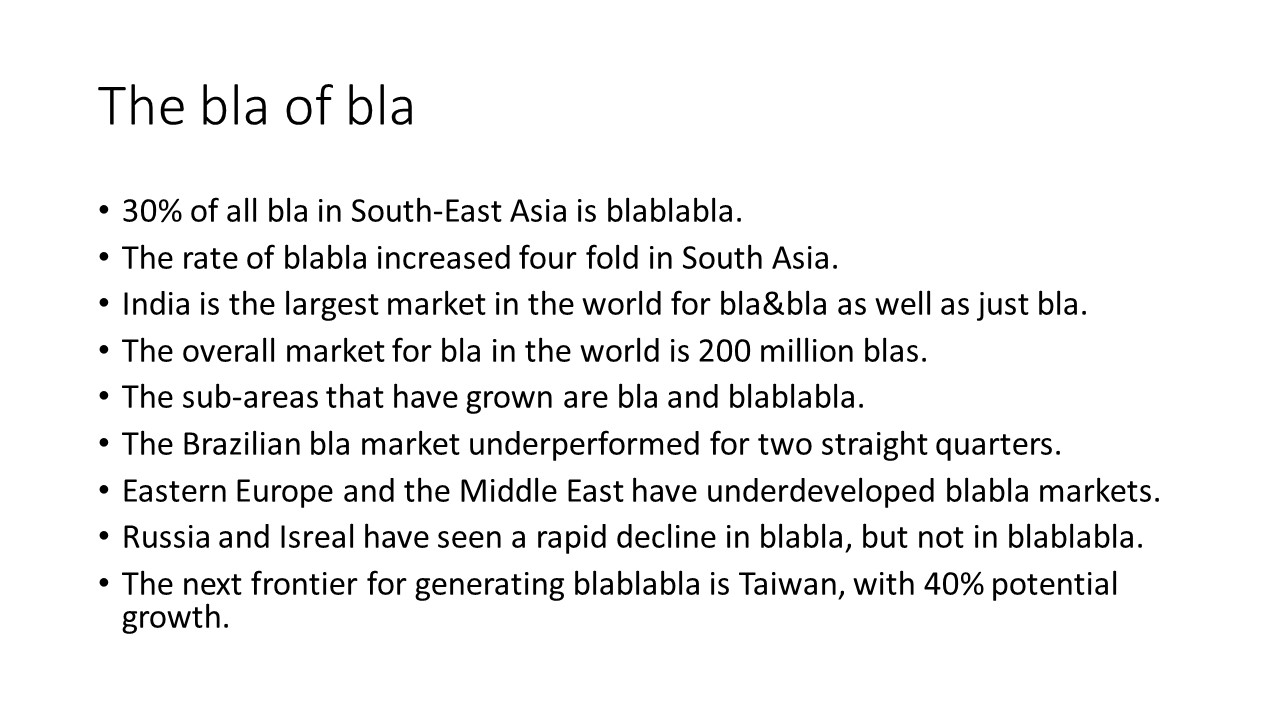
When it come to information on your slides, pack it in! After all, your audience deserves to know all the facts and figures. Be comprehensive when it comes to sharing data. Don’t be stingy.

You may have heard that there should be a maximum of three points per slide. That kind of advice will not help you made a terrible presentation.

Here is a sample slide, showing how it is done:

Imagine your audience squinting their eyes as they read bullet point to bullet point while you are yakking away. Wouldn’t all this information and data overwhelm them? Confuse them? The answer is yes. And rest assured you are on your way to becoming a really bad presenter.

Following these 3 tips will ensure that you make a terrible presentation. Guaranteed.

I have attended many presentations, and you would be surprised how many times people actually follow these three points. Some people don’t prepare enough. Quite a few have poor body language, and inconsistently make eye-contact. And many people crowd their slides with information, overwhelming their audience, and at times, themselves.

At this point, you’ll be asking: how can I become a good presenter?

I doubt your ambition is to be a bad one. If you have any specific questions about the qualities of a good presenter, let me know.

In the meantime, you can check out these links. This one is on signposting language, which you absolutely must know. It is key to becoming a better presenter.

To use your voice effectively, you need to pause . Pausing at the right places makes a big difference. It gives the audience time to absorb what you have said. And it gives you control over your voice.

Do you want to make your presentation slides look better? Read this article on three tips for PowerPoint slides.

And watch this short video on 3 tips to improve your general presentation skills.

For a deeper dive into the topic, read this article on how to give a killer presentation. Towards the end of the article is a list of 10 ways to ruin a presentation. Do read it.

If you have any crazy advice on how to become a bad presenter, let me know in the comments section below.

Definite and indefinite articles

This post is about articles such as a and the. After reading the heading, if you thought that this is about newspaper articles, or how to write articles for your blog, then click away. But, if you wish to know more about a’s and an’s, stay and bravely read on.

You’re still here! Articles are overlooked words which add meaning and set the tone in a piece of writing. Learners of English many times drop articles or use them inappropriately. This may be because in their mother-tongues there are no articles. So, if you are in that boat, no worries. You’ll have to prepare your mind to use articles correctly. As always, slow and steady.

Let’s get down to business. There are three articles — the indefinite articles (a, an) and the definite article (the).

Oops… Did I say three articles? Actually, there is one more, an invisible article. Are you aware of such a mysterious article being present (and not present) when you read sentences in blogs, newspapers, and novels?

Before we look at this invisible article, let’s talk about the visible ones.

We use the indefinite article a before a word that starts with a consonant sound. So that would be a face mask or a video call. And we use the indefinite article an before a vowel sound. For example: There is an alligator under your chair or an octopus in the kitchen sink, or an orangutan at the door.

If your doorbell just rang, open the door slowly. Not because orangutans are dangerous, but because you (with your face mask and face shield) might frighten the poor creature. (Hey, I’m just trying to spice up your lockdown life.)

We return to the use of articles. Here comes the tricky part. (What fun would there be if language was without any trapdoors?) So here is the question. (Drum roll, please.) Is it an university? Or a university? Think about.

Read the previous paragraph. What’s the first sound in that word? Although university starts with a vowel, the first sound is a consonant sound. Let’s change tracks, and talk about food.

Picture this. You have taken the first spoonful of your favourite dessert. It’s been a while since you’ve had it, and you exclaim to the whole world: YUM! The first sound in that yum is also the first sound in the word university. It’s a consonant sound. And that is why we have — a university.

The same goes for the phrase European company. It is a European company and not an European company. Clear? Oh… It’s not. Okay, let me elaborate. In the word European, the first sound is a consonant sound. And that sound is the same as the first sound in that most expressive of words: yum.

We use the definite article the to talk about someone or something specific. What’s the difference between: give me a piece of chocolate cake and give me the piece of chocolate cake? In the first sentence, I’m taking about any piece of chocolate cake that is on the table. I’m not referring to a specific one. But, in the second sentence, both of us know which piece of cake I have in mind.

We have shared knowledge.

Now that we have a basic overview of the use of the visible articles, let’s look at how they are used in the real world.

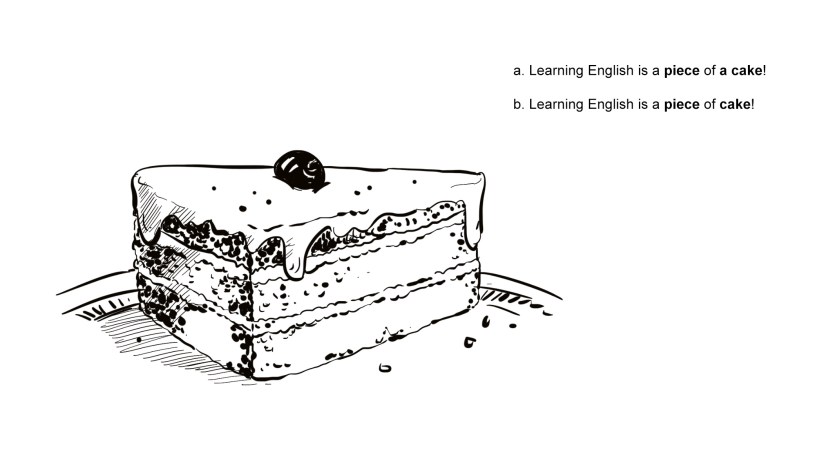
Is it: a. Learning English is a piece of a cake! b. Learning English is a piece of cake!

The image is an illustration of a slice of cake.

The answer is b.

When speaking, some people drop/add articles in common expressions. For example, someone told me, “We need to think out of box.” Instead, it should have been, “out of the box.” There are many more cases of this innocent dropping/adding of articles. Keep your ears peeled when people speak.

At the beginning of this post, I said that articles are overlooked words. There is, however, a class of people who pay special attention to these shortest of words. Writers, poets, and wordsmiths, know the value of articles. Marin Luther King Junior, the American civil rights activist, recognized the power of articles. In his famous 1963 speech he used articles to spectacular effect. The title of his speech is ‘I have a dream’. Note: It is not: ‘I have the dream.’

By using the indefinite article, a, the speaker is being understated. There are many dreams out there. This is my dream. By being understated, he amplifies the message. He makes it universal. Here is an excerpt from his speech:

I say to you today, my friends, though, even though we face the difficulties of today and tomorrow, I still have a dream. It is a dream deeply rooted in the American dream.

The articles are in bold. The definite article, the, is used twice, referring to something specific — the difficulties of today… the American dream…. (The audience on that day in 1963 knew exactly what he was referring to. There is shared knowledge between the speaker and his listeners.) Let’s turn our attention to the use of indefinite articles. He uses the phrase — a dream — in the first sentence. In the second sentence, he could have gone with — ‘It is the dream deeply rooted…’ But, where is the poetry in that? The phrase ‘I have a dream’ is used many times in the speech. This repetition brings rhythm, meaning, and poignancy to his message. To understand how that rhetorical magic happens, we need to recognize the presence and nuanced influence of our one letter word — a.

In the next installment, we’ll look at some more uses of articles in the real world away from the pages of grammar books. We shall also meet that elusive fourth article that keeps such a low profile.

In the meantime, watch this video. And when listening, think about the ‘a’ in “I have a dream.” Now, that is a powerful use of the indefinite article.

Three tips for PowerPoint slides

How did business ever get done without a PowerPoint presentation?

It is hard to imagine making a presentation nowadays without clicking from slide to slide. Whoever you are and whatever you may be doing, there is a high probability that your presentations consist of a series of slides containing words, graphs, and images.

When preparing slides, here are my tips:

  1. Make sure there is lots of white (or blank) space on your slide. Do not crowd the slide with text. I have seen slides which are covered, top to bottom, with sentences. When that happens, the audience spends more time trying to decipher the text, and less time listening to you. Cut, cut, cut. Be ruthless. Place only what is essential on the slide. Yes, less is truly more.
  2. There needs to be coherence between the text and the image/graph. The words and image need to support each other. If the image is self-explanatory or conveys meaning by itself, text may not be necessary. The text and elaboration can come from you, when you speak. When it comes to a slide with text, perhaps one word would suffice. It may have more impact than a full sentence. Remember the first point: be partial to blank space.
  3. Sequencing is important. Make sure there is a logical flow when it comes to structuring your presentation. Decide which slide needs to come where in the overall sequence. Also, for every slide, decide on the sequence of points. You may choose to sequence points based on their order of relevance for a particular message you are trying to convey. And, think about the sequencing of information within a point. Should it be x,y,z or z,y,x? Perhaps, for a certain client you want to highlight z, then in that case, z should come first.

It actually takes strong clarity of purpose to make a ‘simple’ and elegant slide. You need to know what to include and what to exclude. And you need to know how to present material in an appealing way, that makes your audience interested and engaged.

Well-prepared, thoughtful slides make a positive impact on the viewer. She will better remember your presentation after it is over. So, it would be well worth your time to take a step back and critically evaluate your slides with a fresh pair of eyes.

Why do you make the same language errors, again and again?

Fossil

Why do people keep repeating the same grammatical and vocabulary errors, even after they have been corrected?

For example, language learners learn that one should say ‘equipment’ and not ‘equipments’. The reason behind it is that ‘equipment’ is an uncountable noun, and so one shouldn’t add an ‘s’ to it. The phrase three equipments is grammatically incorrect. When I say this in a session, people nod their heads in complete agreement. But, when they leave the room, and have a conversation, they are more likely to ask: Where are the equipments?

Why are they repeating this error? The clue is in the photo of this post. The photo is of a fossil. The language errors that we make are fossilized in our minds. This means that even if the trainer corrects you in a session, afterwards, when you speak with friends or colleagues, you are likely to return to making the same error.

Can you de-fossilize your language? Yes, you can. But you have to work at it.  Pay attention to how you speak and write. And mentally note down the errors which you know you are making. (I monitor my speech, almost, all the time.)

Over time, when you speak and write, you will use the grammar point or word, accurately and effortlessly.

Signposting language for presentation skills

The photo shows three wooden signposts pointing in two directions. The image reflects the topic signposting language for presentation skills.

What is signposting language?

When you travel on the road, there are signs which give information.

A sign could tell you the number of kilometers between you and your destination. A sign may warn you about a sharp turn just ahead. Another sign could tell you to slow down to a particular speed.

While driving, signs are helpful. 

Imagine a road journey without any signs.

Wouldn’t that make you feel uncomfortable? Wouldn’t you be surprised to find that you have to make a hairpin turn without any warning?

What if a wild animal suddenly darts in front of the car?  I’m sure you would have preferred to be warned about something like that. You could then be mentally prepared to better respond.

Yes, signs on the road are essential. They help us to reach our destination safely. At times, they may even save our lives.

Signs are important when making presentations as well.

In a presentation, there are words, phrases, and sentences that give structure and a sense of direction to the audience.

For example:

‘Today, we’ll be focusing on three key issues affecting production in China.’

‘My presentation is divided into two parts.’

‘The presentation will be for 10 minutes.’

All this language (Today, we will look at three key issues… My presentation is divided into…) is called signposting language.

Signposting language is important because it helps your audience to listen better. They become more engaged. 

It gives your audience a sense of control.

This is because they know what to expect (e.g. the talk is for 10 minutes). Also, the audience will be able to understand the progression of your presentation from one stage to the next.  This will make it easier for them to absorb and retain what you say.

By providing structure, signposting language alerts your listeners to key messages and important transitions within your presentation. 

Signposting language can help you when preparing

Here is something many people do not know. Signposting language helps you–the speaker. You start thinking about the logical flow of your presentation. It makes you consider how to sequence the main points.

It may even help in generating new ideas or new ways to present a topic.

For instance, just by saying: my presentation is divided into two parts, you may gain clarity on how you want to present your thoughts and ideas. You may even think that it would be better to divide the presentation into three rather than two parts. 

When preparing for your next presentation, use some of the signposting language given below for introductions, middle parts, and endings. 

When presenting, signposting language gives you a sense of direction and control over your thoughts.

For example, when you say–okay, now that we have discussed the customer survey questions, let’s review the key findings–you are preparing yourself mentally to present the next part of the presentation. 

To sum up about the importance of signposting, it helps both the presenter and the listener. Signposting language provides structure. And having structure is vital. You know that. 

Use of voice

Be aware of how you use your voice when using signposting language. 

Emphasize signposting language.

For instance: FIRST, we will look at customer feedback. SECOND, we’ll look at how we analyze that feedback. And FINALLY, how we use the feedback to make changes in our processes. 

You should pause after using signposting language. 

For example, after saying in conclusion, pause before saying what you want to say.

Pausing makes a difference.

It signals to the audience to pay attention to what comes next.

It gives you time to gather your thoughts and choose the most appropriate words. After the pause, when you speak, you speak with confidence.

Here is some signposting language:

Signposting language to use for introductions

Good morning, my name is …

Hello, my name is … I am a ….  And have been in this sector for the past …. years. (to establish your credentials) 

I’m going to talk about …

I’ll be going over…

My presentation is divided into three parts… To begin with, we will look at …. Then, we will turn to… And finally, we will consider …

The presentation will be for 15 minutes. After the presentation, we will have 10 minutes for Q&A.

Signposting language for the middle of your presentation

Introducing the main parts of the presentation

The first point is… The second point is… And the last point is… 

Transitioning from one part to the next

Moving to the second point…

Now let’s turn to…

Now let’s consider…

We have talked about X in some detail, so let’s now look at Y.

Transitioning to a sub-part 

An example of this is…

When we look at the graph, what is striking is…

As you can see from this slide…

Signposting language to use for the end of your presentation 

To summarize…

To sum up…

So, let’s review…

To conclude…

The most important point to remember is…

The takeaway from today’s talk is…

The end 

Signposting language does its work quietly and efficiently. It allows you to control the direction of your presentation. It gives the audience a road map–telling them where they are and where they are going to. 

Do you have to make a presentation soon? Use signposting language.

You will feel the difference. 

Want more signposting language? Visit BBC Learning English

This post tells you how to be a bad presenter. Of course, once you read it, you’ll know how to be a better one.

FAQs

What is an example of signposting in a presentation?

Signposting tells the listener about the structure of the presentation.

Here is an example: This presentation is divided into two parts. First, we will look at X, and then we’ll talk about Y.

We use signposting language when transitioning to a new point: Now that we have looked at X, let’s talk about Y.

And to signal the conclusion: This is what I want you to remember … 

What is signposting language?

Signposting language consists of words, phrases, and even sentences the presenter uses to give structure and direction to her speech.

At the start of the presentation, signposting language could be: This presentation will be for twenty minutes. After which, there will be a Q&A session for about ten minutes. 

An example of signposting language in the middle of the presentation is: Now that we have reviewed how the data was collected, let’s turn to how it was analyzed

And at the end of your presentation, you could use this signposting language: The key takeaway is ….

Image credit: https://www.vecteezy.com/