
 Its or it’s. What’s the difference?
Is this correct? Its my life. Nope. Why not? Because there is no verb in that sentence. It should be: It’s my life.
It’s can mean two things: it is — or — it has. It all depends on the context. In our example sentence — It’s my life = It is my life. It is not: It has my life.
Let’s look at another sentence: It’s been a while since we last met. Now, here, it’s = it has.
Its is another dish altogether. And it has two different and distinct flavors.
1. Possessive pronoun
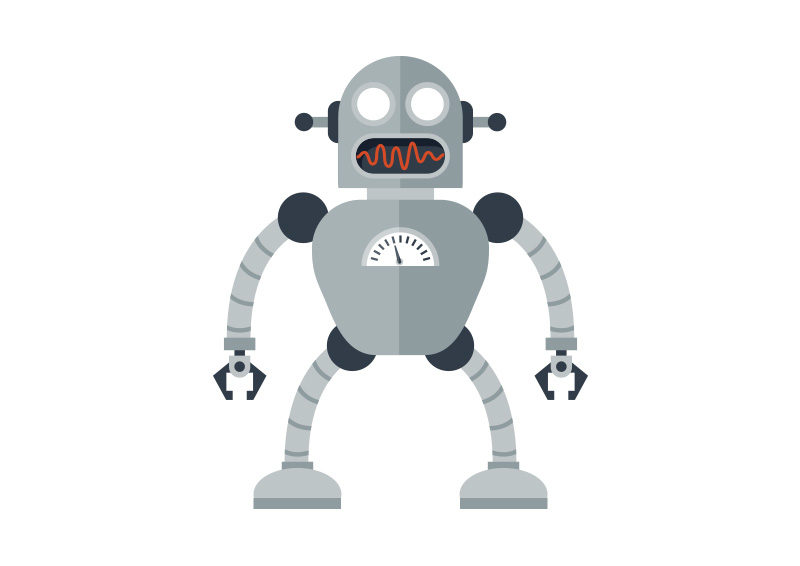
image from: superawesomevectors.com
Imagine you have a robot (like the one above). In general, we consider a robot to be a thing. So we would say: it is washing the dishes.
Let’s look at some dialogue —
Your friend: Whose book is that?
You (pointing to the robot): Oh… That’s its.
Your friend: I didn’t know robots can read.
That is one way of using its. Here its acts as possessive pronoun. If the book was yours, you would say: Oh… That’s mine. (Mine is another possessive pronoun, by the way.)
You are still reading this post. That means you are determined to understand it’s vs its. A positive sign. We have one more use of its and then we’re done. Promise.
2. Possessive adjective
A friend asks you: Whose book is that?
You (pointing to the robot): Oh… That’s its book.
Here its acts as a possessive adjective. It gives us more information about the book. If it is your book, you would say: Oh… That’s my book.
Do you get it?
Are you a bit confused? I hope not. Don’t worry about all the grammatical jargon (possessive pronoun, possessive adjective). Just think about when to use it’s and its.
Keep in mind that its can be used either as a pronoun (a word that replaces a noun) or as an adjective (a word that describes a noun).
Phew! Done.
Next time someone emails you: Its okay. You know what is not okay!
For more on grammar, read these posts on articles and prepositions.
 amalfabian