The definite article

Once upon a time, people used to stay at hotels. It was either for business or for tourism. They would check-in and then, after a day or two, check-out. I know, I hear you. We are living in unprecedented times.

Those ‘normal’ days shall return. And my wishes go out to all those reading this post who are from the hospitality sector.

Now, let’s talk about the the — the definite article.

Which option is correct?

a. The film crew is staying at Oberoi.

b. The film crew is staying at the Oberoi.

(By the way, that’s the name of a hotel group in India, in case you are not from around here.)
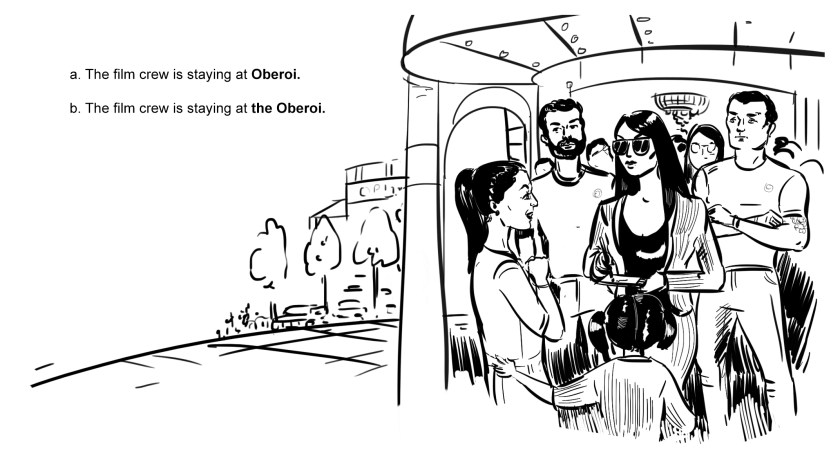
The image is of a movie actress signing autographs at a hotel.

Yes, it’s a. You’re 100% correct. This aspect of grammar comes naturally to you.

No, it’s not. Sorry for that. The correct answer is b. (I’m not sure whether you were actually considering the two options, or have just scrolled down to find the answer. So, I need to keep you on your toes. It’s for your own good. Trust me.)

When it comes to hotels, most of the time, we use the definite article the. So, we stay at the Oberoi, or the Taj, or the Radisson, or the Hyatt.

There is an ad with the line: ‘Take me to the Hilton.’ That’s a memorable line.

The definite article, the, creates a feeling of intimacy in the mind of the reader — an example of the subtle, yet effective, influence of the.

Here is another use of the.

Which is the correct option?

a. The conference focuses on opportunities in Middle East.

b. The conference focuses on opportunities in the Middle East.

You may have selected the correct answer (which is b), but tricky it is, especially if someone asks: but why? Don’t skim this part of the post. Slow down. Read carefully. It will help you someday.

With country names we usually do not use the definite article the. There are some exceptions (of course) such as the Netherlands and the Philippines.

However, we use the definite article the before a collection of states. For example: There are many Canadian companies operating in the United States of America. The USA is a collection of states. Similarly, you can live in the European Union, travel to the United Arab Emirates, and then visit your friend in the United Kingdom.

We use the definite article before the phrase: Republic of ______.

So you can start a company in the Republic of South Africa. And you can purchase machinery from the Republic of Korea.

Let’s talk about the Middle East (from the conference above). When it comes to place names that are ‘adjective + place’, we use the. Middle = adjective. East = place. So, there are many logistics companies in the Middle East.

When referring to geographical areas, I suggest you do a bit of research (a one-minute google search should suffice) before adding or subtracting the definite article.

It is: the company has a strong presence in Southeast Asia. And not in: the Southeast Asia. And you’ll have the definite article when saying: the company has a strong presence in the Southeast Asian market.

My previous post gives an introduction to articles. Do read it to get a better understanding of the basics.

Have you ever heard of the zero article? You may be pleasantly surprised to find out about it.

Are you curious to know more about the use (and misuse) of articles? Check out my latest book on Amazon.
Definite and indefinite articles

This post is about articles such as a and the. After reading the heading, if you thought that this is about newspaper articles, or how to write articles for your blog, then click away. But, if you wish to know more about a’s and an’s, stay and bravely read on.

You’re still here! Articles are overlooked words which add meaning and set the tone in a piece of writing. Learners of English many times drop articles or use them inappropriately. This may be because in their mother-tongues there are no articles. So, if you are in that boat, no worries. You’ll have to prepare your mind to use articles correctly. As always, slow and steady.

Let’s get down to business. There are three articles — the indefinite articles (a, an) and the definite article (the).

Oops… Did I say three articles? Actually, there is one more, an invisible article. Are you aware of such a mysterious article being present (and not present) when you read sentences in blogs, newspapers, and novels?

Before we look at this invisible article, let’s talk about the visible ones.

We use the indefinite article a before a word that starts with a consonant sound. So that would be a face mask or a video call. And we use the indefinite article an before a vowel sound. For example: There is an alligator under your chair or an octopus in the kitchen sink, or an orangutan at the door.

If your doorbell just rang, open the door slowly. Not because orangutans are dangerous, but because you (with your face mask and face shield) might frighten the poor creature. (Hey, I’m just trying to spice up your lockdown life.)

We return to the use of articles. Here comes the tricky part. (What fun would there be if language was without any trapdoors?) So here is the question. (Drum roll, please.) Is it an university? Or a university? Think about.

Read the previous paragraph. What’s the first sound in that word? Although university starts with a vowel, the first sound is a consonant sound. Let’s change tracks, and talk about food.

Picture this. You have taken the first spoonful of your favourite dessert. It’s been a while since you’ve had it, and you exclaim to the whole world: YUM! The first sound in that yum is also the first sound in the word university. It’s a consonant sound. And that is why we have — a university.

The same goes for the phrase European company. It is a European company and not an European company. Clear? Oh… It’s not. Okay, let me elaborate. In the word European, the first sound is a consonant sound. And that sound is the same as the first sound in that most expressive of words: yum.

We use the definite article the to talk about someone or something specific. What’s the difference between: give me a piece of chocolate cake and give me the piece of chocolate cake? In the first sentence, I’m taking about any piece of chocolate cake that is on the table. I’m not referring to a specific one. But, in the second sentence, both of us know which piece of cake I have in mind.

We have shared knowledge.

Now that we have a basic overview of the use of the visible articles, let’s look at how they are used in the real world.

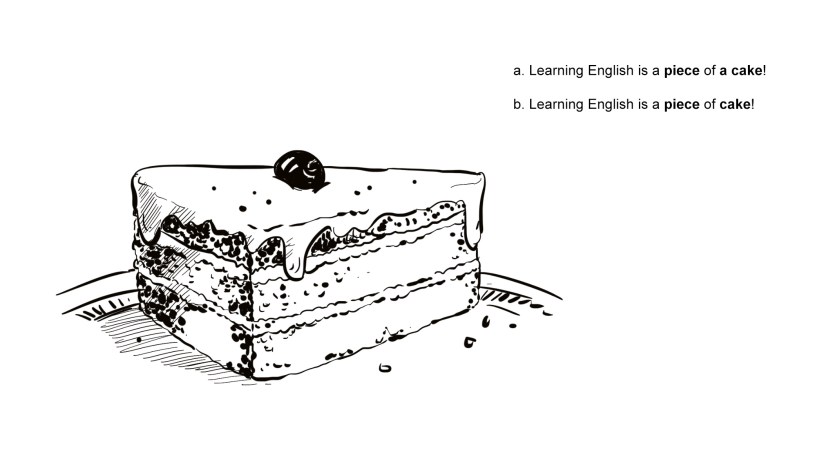
Is it: a. Learning English is a piece of a cake! b. Learning English is a piece of cake!

The image is an illustration of a slice of cake.

The answer is b.

When speaking, some people drop/add articles in common expressions. For example, someone told me, “We need to think out of box.” Instead, it should have been, “out of the box.” There are many more cases of this innocent dropping/adding of articles. Keep your ears peeled when people speak.

At the beginning of this post, I said that articles are overlooked words. There is, however, a class of people who pay special attention to these shortest of words. Writers, poets, and wordsmiths, know the value of articles. Marin Luther King Junior, the American civil rights activist, recognized the power of articles. In his famous 1963 speech he used articles to spectacular effect. The title of his speech is ‘I have a dream’. Note: It is not: ‘I have the dream.’

By using the indefinite article, a, the speaker is being understated. There are many dreams out there. This is my dream. By being understated, he amplifies the message. He makes it universal. Here is an excerpt from his speech:

I say to you today, my friends, though, even though we face the difficulties of today and tomorrow, I still have a dream. It is a dream deeply rooted in the American dream.

The articles are in bold. The definite article, the, is used twice, referring to something specific — the difficulties of today… the American dream…. (The audience on that day in 1963 knew exactly what he was referring to. There is shared knowledge between the speaker and his listeners.) Let’s turn our attention to the use of indefinite articles. He uses the phrase — a dream — in the first sentence. In the second sentence, he could have gone with — ‘It is the dream deeply rooted…’ But, where is the poetry in that? The phrase ‘I have a dream’ is used many times in the speech. This repetition brings rhythm, meaning, and poignancy to his message. To understand how that rhetorical magic happens, we need to recognize the presence and nuanced influence of our one letter word — a.

In the next installment, we’ll look at some more uses of articles in the real world away from the pages of grammar books. We shall also meet that elusive fourth article that keeps such a low profile.

In the meantime, watch this video. And when listening, think about the ‘a’ in “I have a dream.” Now, that is a powerful use of the indefinite article.