

While visiting the Rachna bookstore in Gangtok, Sikkim I saw these delightful readers. And that got me thinking of the various ways of reading.
That person in a brown robe with a pen in hand seems to be reading for detail. Intensive reading.
On the other hand, the owl behind him seems to be reading for pleasure. Could the owl be reading an engaging novel?
Let’s go through some different ways of reading. I’m sure you use many of these approaches, even if you are not be familiar with their names.
Different ways of reading
Scanning
You do this when when scrolling for a particular name on your phone.
When we are scanning a text, we are searching for a specific piece of information. It could be a name, address, number, or percentage. For example, at the airport, you may be scanning the list of flights on a screen. You stop when you find your flight number.
You may be scanning this post right now–searching for any new pieces of information.
Scanning is a useful sub-skill of reading. It saves time.
But, sometimes, you need to do more. Reading needs to be more meaningful.
Skimming
When you need to understand the main idea of a text–the gist of the text– then skim.
Here are some steps to follow:
- Read the title. Look at the photo (if there is one). Predict what the text is going to be about. Take just a few seconds to do this. This helps you prepare your mind to better absorb the text.
- Read the first paragraph. This will give you a good idea as to what the writer intends to say.
- Read the first sentence for each paragraph. This first sentence is a topic sentence. At times, you may need to read the first two sentences to get a good understanding of the topic of the paragraph. For the time being, ignore detailed explanations and examples. When skimming, you are searching for main ideas. No distractions.
- Read the last paragraph. That concludes the text and would contain the main takeaways.
Intensive reading
Remember your school days? The day before the exam–your nose buried in a text book. You were doing intensive reading. (I hope.)
This kind of reading is reading to understand the text in a detailed manner. You pay attention to vocabulary, grammar, information, and arguments. You make inferences. You try to absorb the text.
Adults may be doing intensive reading when reading a report. If you are a scientist, it could be a scientific report. If you work for a company, it could be the company’s annual report.
This kind of reading requires you to pay attention. To focus.
Extensive reading
This is my favourite kind of reading. Reading long texts for pleasure.
Nowadays, not many people read for pleasure, but they should. Reading a long article or a novel broadens your horizons. It makes you better able to relate to other people. Better able to empathize.
Extensive reading builds vocabulary. This is the best way to learn new words. You come across words in their natural setting–in a sentence. I have met students who prefer to learn new words from lists. That is not an effective way to learn new vocabulary. You need to find words in their context. Extensive reading is the answer to vocabulary building.
In this world of AI, it is important for you to be able to synthesize data. To connect the dots. To be creative. Extensive reading will help you.
Putting it all together
How do you usually read? Lots of scanning and some skimming?
Now that you are aware of these reading sub-skills, notice yourself when reading. How do you read?
When reading online articles, we could use a mix of sub-skills. Let’s apply those sub-skills to this article on language learning. Click on the link and quickly plan how you would read the article. Then return to this page.
Are you back?
Let’s look at how to approach the article together.
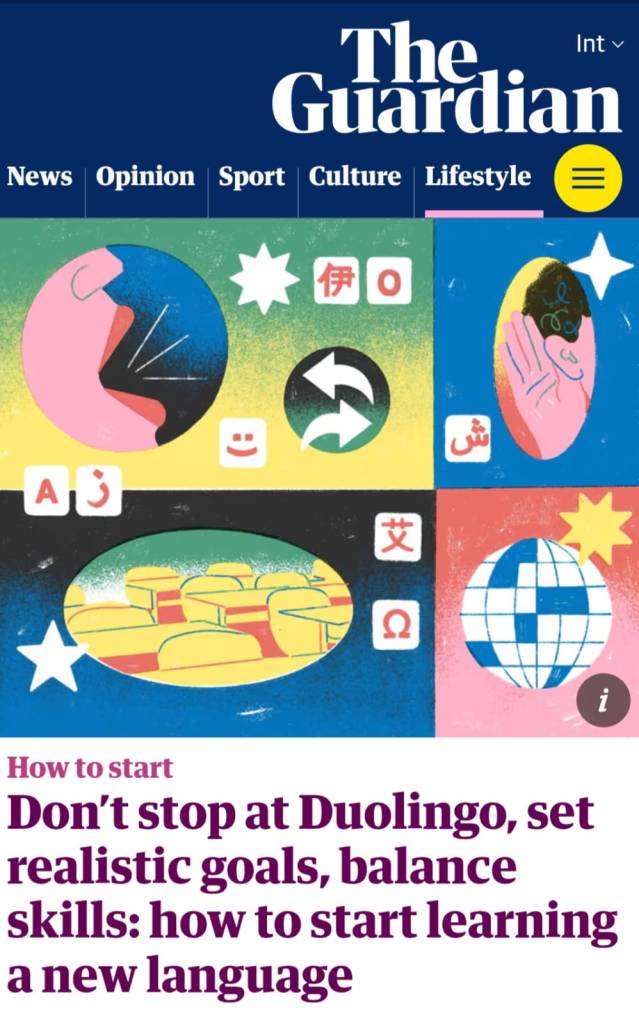
- Read the main heading. Look at the image. Predict what the article is about. For instance: I see a hand to a ear. Will the article talk about the importance of listening in language learning?
- Read the paragraphs under the heading: Language experts say you should learn in the right order and shift to a growth mindset. That will give you a good idea of what the writer intends to cover. Do keep in mind that in online articles paragraphs have become shorter, so you may need to read the first three or four (short) paragraphs to get an idea of text.
- Scan the sub-headings. Is there anything that interests you? If so, stop and do intensive reading. For example, I slowed down when I saw the sub-heading: How do humans learn languages?
Or
You could skim the entire text and then decide if you want to read any paragraph in greater detail. Skimming the text means reading the first sentence, and perhaps the second one as well. At times, the second sentence could be the topic sentence.
When you read next time…
Having a reading strategy will help you become a more effective reader. Try the steps the we looked at the next time you read an article or report.
By consciously applying these reading sub-skills, you’ll use your time more efficiently. You’ll be better able to identify and remember key points. And then you could take a well-deserved break, just like that brown-robed person snoozing on the couch. Scroll up to see him.
 amalfabian