Where are you right now? During these lockdown days, most probably, you are in home. Correct? No. That sentence is grammatically incorrect. You are at home. Prepositions when it comes to spaces can get tricky. I know.
We use in when talking about a well-defined space. So, my guess is that you are reading this post in a room. When it comes to the preposition in you can say: in my building, there are thirty flats. If you are feeling hungry, there are muffins in the box.
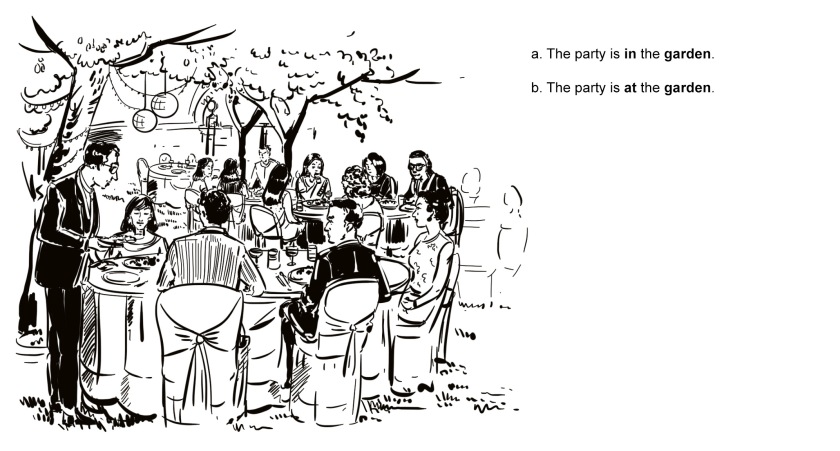
So, here comes the question. Don’t mull over it. Go with your gut feeling. You have two options: a. The party is in the garden. b. The party is at the garden.
Did you say in the garden? Woohoo! That’s correct. A garden is a well-defined space and so we use in. If you got it wrong, no worries. Now you know.
When we talk about spaces that have a specific purpose, then things change. We usually use at. That’s why it is at home and not in home. The word home has specific emotions and meanings attached to it. It’s not a random place.
Now, picture this. You are flying to Colombo for a meeting. You call your friend and say, “Hey, I am at the airport. Do you want me to buy anything for you?” Note that you said at the airport, and not in the airport. So when it comes to airports, train stations, and other places with specific purposes, use at.
This is the really tricky part. Let’s look at another place: a hospital. If you are at the hospital visiting a relative who is a patient there, you say: I’m at the hospital. On the hand, if Rahul is a patient, you say: he is inhospital (UK English). In US English, it would be: he is inthe hospital.
There is more I’d like to tell you about prepositions, but I want these above points to sink in, nice and slowly. So, I’ll end the post here.
If you would like to read my first post on prepositions, click here.
And here is a short video on common errors in the use of prepositions.
Still want more on prepositions? Visit British Council Learning English for prepositions of time and of place.
Some people get emotional when talking about prepositions. It’s true.
I remember a learner who asked me: Why in a chair and not on a chair? His face was distressed, and he was searching for logical reasoning. If you are not sure, by the way, it is: He is sitting in a chair.
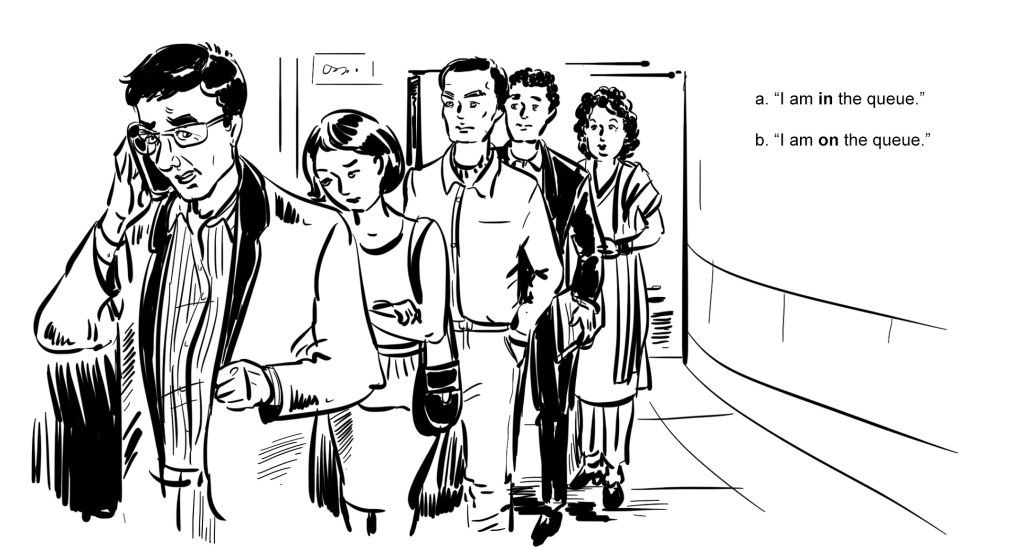
During demonetization a lot of us were standing in front of ATMs, just like these people below. Is that person, who is on the phone, saying: a “I am in the queue.” or b “I am on the queue.” ? (Assuming he knows his prepositions.)
The answer is a.
Many people would have gone for b. In India, we like to use ‘on’ a lot. I don’t know why. When learning English as second language, prepositions can be tiny, tricky words to handle. Is it in or on? At or in? Is there any logic to it all?
My advice is to take it one preposition at a time. Learn it as a chunk with other words that go with it. I’ll give you some reasoning as well. But, for the most part, see if you can naturally associate a preposition with a noun. After some effort, it should be effortless. Automatic.
In this post, let’s look at some commonly used prepositions. A Bollywood actor would say a sentence like: I live in Mumbai. With a city, town, neighborhood, or village, the preposition is in. So, it would be: She lives in Bandra.
Close your eyes. Okay, that may not be practical when you have to read the next sentence. Keep them open. Imagine this. You are on a flight heading to New York. The plane halts in Paris for one hour. You call your friend and say: The plane is at Paris for an hour. No time to visit the city!
Here, if you noticed, we used at and not in. We use at when we are at a point in a journey. We use at with car journeys and train journeys as well. Try it sometime, maybe after this whole crazy covid-19 crisis is over.
When travelling by public transport, where in general you can move around, use on. So, Shilpa is on the plane. Your brother is on the bus, headed to Mysore. Your manager is on the metro. That’s right, on the metro, because it is public transport, and you can move about. For instance, you can walk from your seat to the opening door. If you are travelling in New York, you would say into your cellphone: Hey, I’m on the subway.
In transport that you cannot walk about, where your movement is severely restricted, use in. ‘I’m in an Uber cab.’ And of course, ‘I’m in your car. Where are you?’ If you are sitting on the roof of the car, then you say: ‘I’m on your car.’
If you are taking a private plane (a Learjet, maybe?), where there is not much walking space, you say: I’m in the plane. So, the next time you are in a high-end private airplane, you will know which preposition to use.
Of course, when it comes to a horse, bicycle, or motorbike, you are on and not in. If you are in a motorbike or bicycle, that spells trouble. And I would not wish it upon you.
When you are attending/participating in a group event, use at. So you are at a party, at the match, and at a meeting.
At a meeting? I see you scrunching your eyebrows at that phrase — at a meeting — while saying to yourself hmm. Can’t I say in a meeting? I’ve heard that before, many times. Well, you can. But the meaning is a bit different. At a meeting means that you are, well, attending a meeting. Now, say for instance you are attending a marketing meeting, and your phone rings. You respond with a message: I’m in a meeting. I’ll call you back. This means that you are busy, very busy, and that you will call that person after you have finished with the meeting. The emphasis is on you being engaged in an activity (the meeting).
If you would like to know more about prepositions, do check out Common Indian Errors in Business English. This book looks at the use (or misuse) of prepositions by Indian speakers. It covers other topics as well, such as the use of articles and uncountable nouns. The book is full of images and multiple choice questions, just like the above illustration in this post. By the way, I am its author. And, here is the cover:


 amalfabian