
Different ways of reading

While visiting the Rachna bookstore in Gangtok, Sikkim I saw these delightful readers. And that got me thinking of the various ways of reading.

That person in a brown robe with a pen in hand seems to be reading for detail. Intensive reading.

On the other hand, the owl behind him seems to be reading for pleasure. Could the owl be reading an engaging novel?

Let’s go through some different ways of reading. I’m sure you use many of these approaches, even if you are not be familiar with their names.

Different ways of reading

Scanning

You do this when when scrolling for a particular name on your phone.

When we are scanning a text, we are searching for a specific piece of information. It could be a name, address, number, or percentage. For example, at the airport, you may be scanning the list of flights on a screen. You stop when you find your flight number.

You may be scanning this post right now–searching for any new pieces of information.

Scanning is a useful sub-skill of reading. It saves time.

But, sometimes, you need to do more. Reading needs to be more meaningful.

Skimming

When you need to understand the main idea of a text–the gist of the text– then skim.

Here are some steps to follow:

  1. Read the title. Look at the photo (if there is one). Predict what the text is going to be about. Take just a few seconds to do this. This helps you prepare your mind to better absorb the text.
  2. Read the first paragraph. This will give you a good idea as to what the writer intends to say.
  3. Read the first sentence for each paragraph. This first sentence is a topic sentence. At times, you may need to read the first two sentences to get a good understanding of the topic of the paragraph. For the time being, ignore detailed explanations and examples. When skimming, you are searching for main ideas. No distractions.
  4. Read the last paragraph. That concludes the text and would contain the main takeaways.

Intensive reading

Remember your school days? The day before the exam–your nose buried in a text book. You were doing intensive reading. (I hope.)

This kind of reading is reading to understand the text in a detailed manner. You pay attention to vocabulary, grammar, information, and arguments. You make inferences. You try to absorb the text.

Adults may be doing intensive reading when reading a report. If you are a scientist, it could be a scientific report. If you work for a company, it could be the company’s annual report.

This kind of reading requires you to pay attention. To focus.

Extensive reading

This is my favourite kind of reading. Reading long texts for pleasure.

Nowadays, not many people read for pleasure, but they should. Reading a long article or a novel broadens your horizons. It makes you better able to relate to other people. Better able to empathize.

Extensive reading builds vocabulary. This is the best way to learn new words. You come across words in their natural setting–in a sentence. I have met students who prefer to learn new words from lists. That is not an effective way to learn new vocabulary. You need to find words in their context. Extensive reading is the answer to vocabulary building.

In this world of AI, it is important for you to be able to synthesize data. To connect the dots. To be creative. Extensive reading will help you.

Putting it all together

How do you usually read? Lots of scanning and some skimming?

Now that you are aware of these reading sub-skills, notice yourself when reading. How do you read?

When reading online articles, we could use a mix of sub-skills. Let’s apply those sub-skills to this article on language learning. Click on the link and quickly plan how you would read the article. Then return to this page.

Are you back?

Let’s look at how to approach the article together.
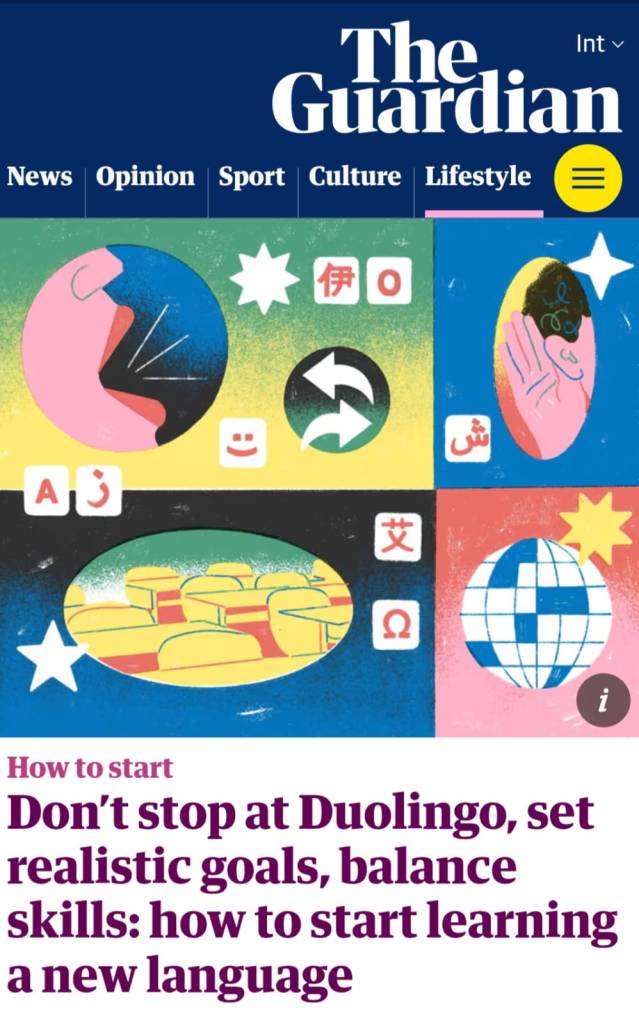
  1. Read the main heading. Look at the image. Predict what the article is about. For instance: I see a hand to a ear. Will the article talk about the importance of listening in language learning?
  2. Read the paragraphs under the heading: Language experts say you should learn in the right order and shift to a growth mindset. That will give you a good idea of what the writer intends to cover. Do keep in mind that in online articles paragraphs have become shorter, so you may need to read the first three or four (short) paragraphs to get an idea of text.
  3. Scan the sub-headings. Is there anything that interests you? If so, stop and do intensive reading. For example, I slowed down when I saw the sub-heading: How do humans learn languages?

Or

You could skim the entire text and then decide if you want to read any paragraph in greater detail. Skimming the text means reading the first sentence, and perhaps the second one as well. At times, the second sentence could be the topic sentence.

When you read next time…

Having a reading strategy will help you become a more effective reader. Try the steps the we looked at the next time you read an article or report.

By consciously applying these reading sub-skills, you’ll use your time more efficiently. You’ll be better able to identify and remember key points. And then you could take a well-deserved break, just like that brown-robed person snoozing on the couch. Scroll up to see him.

How important is English for success? 

Speaker in front of an audience.

There is no clear answer to this question. It depends on your profession. 

Imagine you are a painter from Hyderabad who is in Toronto for an art festival. You know a few words in English to get by. It’s okay. People are not concerned about your level of English. And why should they be? They have come to see your art. 

Similarly, a chef does not need to know English. Of course, it would be helpful. She could explain her dishes better. But, speaking English is not essential. Her food is her message. 

English for business

For jobs in the corporate sector, it is a different story.

In this globalized world, English has become the language of business. According to an article in the Harvard Business Review, companies such as Airbus, Daimler-Chrysler, SAP, and Samsung have adopted English as their common corporate language. 

Interestingly, a Japanese company Rakuten has pursued Englishnization, a language policy that embraces English. The policy requires employees to improve their level of English, or face consequences such as demotion. 

Why did Mr. Mikitani, the CEO of Rakuten, take such a drastic measure?

Mr. Mikitani believes that it was essential for his company’s growth and survival. Rakuten is Japan’s largest online marketplace, with a presence in many countries including the US, UK, Germany, China, Indonesia, and Brazil. To unify communication throughout the network, Englishnization was felt to be necessary. 

English in corporate India 

What is true for Rakuten is true for corporate India as well.

We live in a globalized, competitive world. One of the reasons why the IT sector has done so well in India is that software engineers in Bangalore speak English. 

If you work with an MNC or an Indian company, you have to communicate in English when talking to foreign clients. Even within India, there are clients/vendors in the south and the north-east of the country who may not be fluent in Hindi.

We can agree that English is important in the corporate workplace. But, how high does your level of English need to be? 

How well should my English be to succeed at work? 

To get an entry level job, companies are ideally looking for at least a B2-level speaker — a person who is at the upper-intermediate level. At this level, she communicates with ease and is able to  comprehend the main ideas of complex texts. She is able to write clearly on a wide range of topics, and express her opinions.

In my experience as a corporate trainer, many employees in corporate India are at the B1 level, which is the intermediate level. This means that they can understand information about familiar topics. B1-level speakers can manage their work. 

The key word being manage

There are speakers who speak fluently, but make grammatical errors along the way.

For example, a person may say, ‘I didn’t went to the warehouse.’ Of course, it should be ‘I didn’t go…’.

But does it really make a difference?

Communication is all about being understood. If the listener understands the message, communication has been achieved. 

In many situations, it is alright to make grammatical errors–as long as no confusion is generated.

Even incorrect pronunciation need not be an issue. If the listener understands a strong accent, then there is real communication. Thoughts are exchanged. Work gets done.  

Miscommunication leading to misunderstanding

Things get complicated when speaking to people from other countries. 

Let me give you an example. An irate client in Southeast Asia was talking to an engineer in India. The client complained that some machinery parts were not delivered on time.

The person in India replied, “I could understand your problem.”

This upset the client even more. 

“What does could mean? Does it mean that you don’t understand my problem?” asked the client.

The client escalated the issue.  

The Indian engineer did not understand why the client was so angry. Although the engineer was trying to be empathetic, he was misunderstood. 

As you can see, things get complicated when dealing with sensitive situations. A person may not have the vocabulary to express precisely what he wants to say. 

The need for better communication skills

When you rise up the corporate ladder, more will be expected of you when it comes to communication. For instance, you may have to attend a conference in Singapore, representing your company. At the event, you would want to network. The common language of communication would be English. If you speak the language fluently and clearly, people would find it easier to speak with you. You would be more successful in your networking.

When you become a CEO, you have to make speeches and presentations to wider audiences. The information and thoughts you convey will be more complex and nuanced. Also, you would have to read and absorb information about topics that are not in your domain of expertise. 

To accomplish all of this effectively, you would have to be an advanced-level user of the language, which means at the C1-level . Such a speaker uses language fluently in social, academic, and professional settings. 

Putting it all together 

Now that we have had a bird’s eye view of what is expected in the corporate sector, the picture becomes clearer.

When hiring a junior engineer, executive, or accountant, companies may search for B2-level candidates, but in reality, B1 would be just fine. 

Remember, domain knowledge counts for a lot. Being good at your job is a big advantage. When you know your work well and speak the jargon, you should be able to communicate well enough, even if you are at the B1 level.

Here is a telling quote from Rakuten CEO Mikitani who implemented Englishnization.

“WE HAVE TO BE ONE TEAM. THAT IS WHY I WANT EVERYONE TO BE ABLE TO COMMUNICATE IN ENGLISH. OF COURSE, I’M NOT SAYING IT HAS TO BE PERFECT ENGLISH. I, FOR ONE, MAKE MANY GRAMMATICAL ERRORS. BUT THAT’S FINE. I DON’T WORRY ABOUT IT. AS LONG AS WE CAN UNDERSTAND EACH OTHER, WE DON’T NEED “NATIVE” ENGLISH TO DO GREAT THINGS TOGETHER.”MICKEY MIKITANI, CHAIRMAN AND CEO, RAKUTEN GROUP.

There is a powerful message in what he said: When people are on the same page, and open to collaboration, a lot can be achieved. And you do not need to be a native speaker (that is at the C2 level). Grammatical errors do not impede communication.

I agree with what he says, but with some reservations.

If there are unexpected situations, you may not have the language to express yourself effectively. As we saw in that example of “I could understand….” 

Are you at the B1 level? If yes, I urge you to improve your English to reach the B2 level. The effort will be worth it. You will be better able to handle difficult situations. 

And if you are at the B2 level, put in the hard work to reach the C1 level. There is a big difference between a B2 and a C1 user of the language. Your peers will notice that difference, and so will your clients.    

Beware of the language plateau 

There is something that could prevent you from improving your language: the dreaded language plateau. 

When you begin learning a language, you do so enthusiastically, covering miles of territory. After you arrive at the intermediate stage, your enthusiasm wanes. You need to work much harder to see results. When this happens, you are at the intermediate plateau. (There is an advanced-level plateau as well.) Read this article by Preply to learn more about plateaus. 

To ensure you escape the plateau, find ways to rekindle your enthusiasm for the language. Watch English movies. Read novels. Listen to songs. Be persistent, even when learning does not look as rewarding as it once did.

Persistence will get you to the finish line

Next steps 

If you are keen to improve your language, you need to know your level of English. Many people overestimate their language skills. It would be better to get an objective assessment. A reality check never hurts, at least when it comes to language learning.

Once you are clear as to where you are, start improving your skills. These 3 free websites are useful. 

Why don’t you learn English from the world around you? You could become your own language coach!

If you have any questions, let me know in the comments section below. 

FAQs

Why is English important for success? 

  • We live in a world where the largest economy is the U.S.A. – an English-speaking country.
  • Even many French, German, and Japanese companies use English for internal communication. 
  • To reach a global audience, one needs to know English. 

Why is English important for your future 

  • A lot of information is available in English, when compared with other languages. 55% of online domains are in English. 
  • Being proficient in English will help you better explain your ideas and thoughts in interviews, in meetings, and during presentations. 
  • English will help you with networking, especially when meeting people from other countries.