The zero article

I’ve noticed that many people do not have time to learn about articles. They’re just not bothered, frankly. But, if you don’t use articles correctly, there will be grammatical errors in your presentations, emails and reports.

This is the third post on articles. In the previous posts, we looked at the indefinite and definite articles.

And now, for the grand finale.

Let us find out about that most mysterious article of all, the third type of article, known as the zero article.

To see the zero article, click twice inside the golden frame below. You will have to click twice, quickly. And then focus on the empty space within the frame. (Make sure you look at all parts of the frame, especially the corners.)

Are you ready? Go ahead.

The image is a plain, golden picture frame with no picture in it.
Source: https://in.pinterest.com/pin/679128818778148568/

Did you see the zero article?

What?

Are you saying that nothing happened?

Well, in a sense, that is true.

You see, the zero article is invisible.

Before we talk more about this type of article we need to be clear about two concepts.

Read these two definitions:

  1. Abstract nouns–An abstract noun is a noun that you cannot touch, see, smell, hear, or taste. For example, peace, love, and imagination are abstract nouns.
  2. Plural count nouns–These are nouns that can be counted. Examples are: masks, beds, and vampires. You can say I see: five masks, three beds, and two vampires.

Did you get that?

Okay then.

We use the zero article before an abstract noun or before a plural count noun.

Simple as that.

Here are two sentences where we use the zero article.

Imagination is the need of the hour.

I don’t meet vampires after sunset.

In both these sentences, there is a zero article before the noun–imagination (abstract noun); vampires (plural count noun).

We are almost done here. I need to tell you about the times when we use the definite article the before an abstract noun or a plural count noun.

We use it when talking about something specific.

For instance: The imagination of a child is limitless.

Or: The vampires in my hometown are quite harmless.

In both these sentences, we are referring to a specific type of noun–the imagination of a child; the vampires from my hometown.

Now that you know about the zero article, keep an eye out for it. Not people know about this hidden article.

For more on articles, visit British Council LearnEnglish.
The definite article

Once upon a time, people used to stay at hotels. It was either for business or for tourism. They would check-in and then, after a day or two, check-out. I know, I hear you. We are living in unprecedented times.

Those ‘normal’ days shall return. And my wishes go out to all those reading this post who are from the hospitality sector.

Now, let’s talk about the the — the definite article.

Which option is correct?

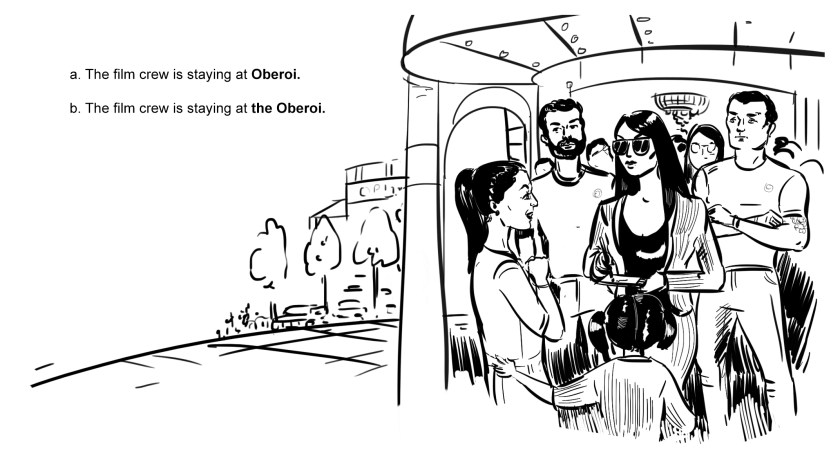
a. The film crew is staying at Oberoi.

b. The film crew is staying at the Oberoi.

(By the way, that’s the name of a hotel group in India, in case you are not from around here.)

The image is of a movie actress signing autographs at a hotel.

Yes, it’s a. You’re 100% correct. This aspect of grammar comes naturally to you.

No, it’s not. Sorry for that. The correct answer is b. (I’m not sure whether you were actually considering the two options, or have just scrolled down to find the answer. So, I need to keep you on your toes. It’s for your own good. Trust me.)

When it comes to hotels, most of the time, we use the definite article the. So, we stay at the Oberoi, or the Taj, or the Radisson, or the Hyatt.

There is an ad with the line: ‘Take me to the Hilton.’ That’s a memorable line.

The definite article, the, creates a feeling of intimacy in the mind of the reader — an example of the subtle, yet effective, influence of the.

Here is another use of the.

Which is the correct option?

a. The conference focuses on opportunities in Middle East.

b. The conference focuses on opportunities in the Middle East.

You may have selected the correct answer (which is b), but tricky it is, especially if someone asks: but why? Don’t skim this part of the post. Slow down. Read carefully. It will help you someday.

With country names we usually do not use the definite article the. There are some exceptions (of course) such as the Netherlands and the Philippines.

However, we use the definite article the before a collection of states. For example: There are many Canadian companies operating in the United States of America. The USA is a collection of states. Similarly, you can live in the European Union, travel to the United Arab Emirates, and then visit your friend in the United Kingdom.

We use the definite article before the phrase: Republic of ______.

So you can start a company in the Republic of South Africa. And you can purchase machinery from the Republic of Korea.

Let’s talk about the Middle East (from the conference above). When it comes to place names that are ‘adjective + place’, we use the. Middle = adjective. East = place. So, there are many logistics companies in the Middle East.

When referring to geographical areas, I suggest you do a bit of research (a one-minute google search should suffice) before adding or subtracting the definite article.

It is: the company has a strong presence in Southeast Asia. And not in: the Southeast Asia. And you’ll have the definite article when saying: the company has a strong presence in the Southeast Asian market.

My previous post gives an introduction to articles. Do read it to get a better understanding of the basics.

Have you ever heard of the zero article? You may be pleasantly surprised to find out about it.

Are you curious to know more about the use (and misuse) of articles? Check out my latest book on Amazon.