
Where are you right now? During these lockdown days, most probably, you are in home. Correct? No. That sentence is grammatically incorrect. You are at home. Prepositions when it comes to spaces can get tricky. I know.
We use in when talking about a well-defined space. So, my guess is that you are reading this post in a room. When it comes to the preposition in you can say: in my building, there are thirty flats. If you are feeling hungry, there are muffins in the box.
So, here comes the question. Don’t mull over it. Go with your gut feeling. You have two options: a. The party is in the garden. b. The party is at the garden.
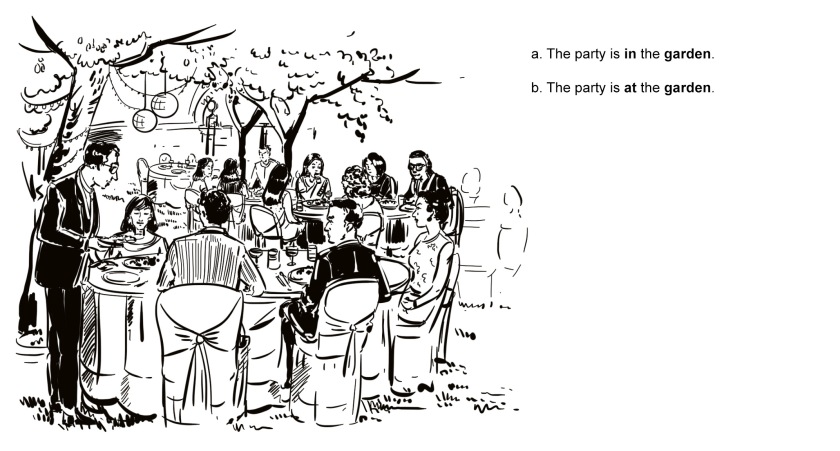
Did you say in the garden? Woohoo! That’s correct. A garden is a well-defined space and so we use in. If you got it wrong, no worries. Now you know.
When we talk about spaces that have a specific purpose, then things change. We usually use at. That’s why it is at home and not in home. The word home has specific emotions and meanings attached to it. It’s not a random place.
Now, picture this. You are flying to Colombo for a meeting. You call your friend and say, “Hey, I am at the airport. Do you want me to buy anything for you?” Note that you said at the airport, and not in the airport. So when it comes to airports, train stations, and other places with specific purposes, use at.
This is the really tricky part. Let’s look at another place: a hospital. If you are at the hospital visiting a relative who is a patient there, you say: I’m at the hospital. On the hand, if Rahul is a patient, you say: he is in hospital (UK English). In US English, it would be: he is in the hospital.
There is more I’d like to tell you about prepositions, but I want these above points to sink in, nice and slowly. So, I’ll end the post here.
If you would like to read my first post on prepositions, click here.
And here is a short video on common errors in the use of prepositions.
Still want more on prepositions? Visit British Council Learning English for prepositions of time and of place.

 amalfabian