Definite and indefinite articles

This post is about articles such as a and the. After reading the heading, if you thought that this is about newspaper articles, or how to write articles for your blog, then click away. But, if you wish to know more about a’s and an’s, stay and bravely read on.

You’re still here! Articles are overlooked words which add meaning and set the tone in a piece of writing. Learners of English many times drop articles or use them inappropriately. This may be because in their mother-tongues there are no articles. So, if you are in that boat, no worries. You’ll have to prepare your mind to use articles correctly. As always, slow and steady.

Let’s get down to business. There are three articles — the indefinite articles (a, an) and the definite article (the).

Oops… Did I say three articles? Actually, there is one more, an invisible article. Are you aware of such a mysterious article being present (and not present) when you read sentences in blogs, newspapers, and novels?

Before we look at this invisible article, let’s talk about the visible ones.

We use the indefinite article a before a word that starts with a consonant sound. So that would be a face mask or a video call. And we use the indefinite article an before a vowel sound. For example: There is an alligator under your chair or an octopus in the kitchen sink, or an orangutan at the door.

If your doorbell just rang, open the door slowly. Not because orangutans are dangerous, but because you (with your face mask and face shield) might frighten the poor creature. (Hey, I’m just trying to spice up your lockdown life.)

We return to the use of articles. Here comes the tricky part. (What fun would there be if language was without any trapdoors?) So here is the question. (Drum roll, please.) Is it an university? Or a university? Think about.

Read the previous paragraph. What’s the first sound in that word? Although university starts with a vowel, the first sound is a consonant sound. Let’s change tracks, and talk about food.

Picture this. You have taken the first spoonful of your favourite dessert. It’s been a while since you’ve had it, and you exclaim to the whole world: YUM! The first sound in that yum is also the first sound in the word university. It’s a consonant sound. And that is why we have — a university.

The same goes for the phrase European company. It is a European company and not an European company. Clear? Oh… It’s not. Okay, let me elaborate. In the word European, the first sound is a consonant sound. And that sound is the same as the first sound in that most expressive of words: yum.

We use the definite article the to talk about someone or something specific. What’s the difference between: give me a piece of chocolate cake and give me the piece of chocolate cake? In the first sentence, I’m taking about any piece of chocolate cake that is on the table. I’m not referring to a specific one. But, in the second sentence, both of us know which piece of cake I have in mind.

We have shared knowledge.

Now that we have a basic overview of the use of the visible articles, let’s look at how they are used in the real world.

Is it: a. Learning English is a piece of a cake! b. Learning English is a piece of cake!
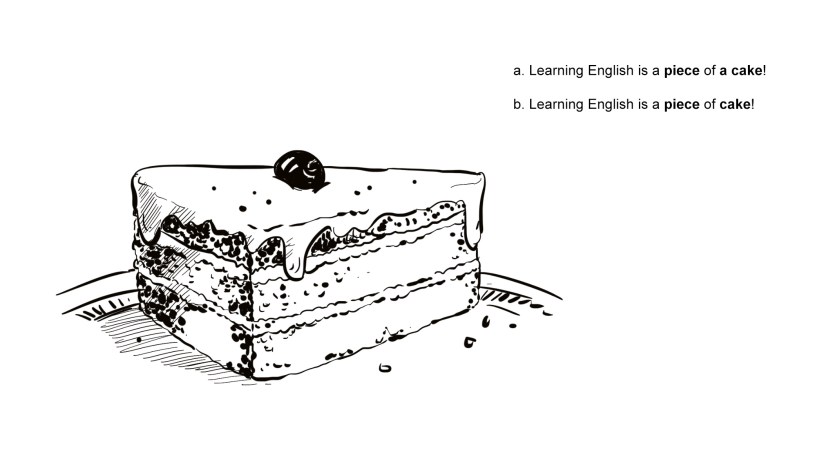
The image is an illustration of a slice of cake.

The answer is b.

When speaking, some people drop/add articles in common expressions. For example, someone told me, “We need to think out of box.” Instead, it should have been, “out of the box.” There are many more cases of this innocent dropping/adding of articles. Keep your ears peeled when people speak.

At the beginning of this post, I said that articles are overlooked words. There is, however, a class of people who pay special attention to these shortest of words. Writers, poets, and wordsmiths, know the value of articles. Marin Luther King Junior, the American civil rights activist, recognized the power of articles. In his famous 1963 speech he used articles to spectacular effect. The title of his speech is ‘I have a dream’. Note: It is not: ‘I have the dream.’

By using the indefinite article, a, the speaker is being understated. There are many dreams out there. This is my dream. By being understated, he amplifies the message. He makes it universal. Here is an excerpt from his speech:

I say to you today, my friends, though, even though we face the difficulties of today and tomorrow, I still have a dream. It is a dream deeply rooted in the American dream.

The articles are in bold. The definite article, the, is used twice, referring to something specific — the difficulties of today… the American dream…. (The audience on that day in 1963 knew exactly what he was referring to. There is shared knowledge between the speaker and his listeners.) Let’s turn our attention to the use of indefinite articles. He uses the phrase — a dream — in the first sentence. In the second sentence, he could have gone with — ‘It is the dream deeply rooted…’ But, where is the poetry in that? The phrase ‘I have a dream’ is used many times in the speech. This repetition brings rhythm, meaning, and poignancy to his message. To understand how that rhetorical magic happens, we need to recognize the presence and nuanced influence of our one letter word — a.

In the next installment, we’ll look at some more uses of articles in the real world away from the pages of grammar books. We shall also meet that elusive fourth article that keeps such a low profile.

In the meantime, watch this video. And when listening, think about the ‘a’ in “I have a dream.” Now, that is a powerful use of the indefinite article.

The power of S l o w L e a r n i n g

tortoise-hare-1584395

Being busy and impatient

People are in such a tearing hurry to learn English. Being impatient doesn’t help.

The search for a quick fix

While conducting corporate training sessions, I noticed that many participants were not really keen to understand, absorb, and appreciate the language point being presented.

They were often looking for a quick fix solution. For example, they want a phrase they can  immediately use in the next conference call.

In their minds there are a finite set of phrases to be used in predictable situations.

In a sense, that is true. But do keep in mind this works only when the phrases and grammar points are directly related to those specific situations.

As you know, the demands of work are not always predictable.

Change happens.

You may suddenly have to make a presentation to a foreign client. Or you may have to describe a complicated technical process via an email to non-experts. Or you may have to give a nuanced response to a reporter.

Imagine this happening: one fine day, you get a promotion and have to communicate a sensitive issue to your senior management. ChatGPT may not fully understand your prompt. Then what?

You must have a direct relationship with the language. 

That relationship cannot be transactional: I’ll attend a business English course for two months and pay attention during the sessions. My English language learning is done and dusted.

Sorry, that won’t work. Language is far more demanding.

Commit to a long-term relationship

You need to build a long-term relationship with the language.

Yes, I’m talking years… Start taking an interest in how other people communicate.

How to improve by yourself

Spend more time reading–analyzing the emails you receive.

  • Is there anything you can learn? (Perhaps a polite phrase that is used.)
  • Is there anything that you do not like about the email? Is it too wordy? Too vague?

When reading a report, step back to see the big picture.

  • Who is the intended audience? Will they understand?
  • Is the report organized logically?
  • How does it look visually? Is it easy to interpret the data from that chart?
  • Are all crucial points adequately covered?
  • Is there any unnecessary information?

Look at it from another perspective.

  • Are there any unstated assumptions?

You could take the same approach when reading your newspaper in the morning.

Read the headline. What is it about? Politics? Economics? The next scandal?

Now, look at the photo. How does the photo relate to the headline?

Spend a few seconds on the photo. Can you spot anything interesting? Out of the ordinary, perhaps? Does the politician’s face project confidence or insecurity?

Is the newspaper trying to make a point by choosing that particular headline to go with that particular photo? Think about it.

What do you think the article is going to be about? Will it have a negative, neutral, or positive slant? Go ahead and guess. Now, read the article.

By making predictions, you prepare your mind to better absorb the article. 

If you practice this way of reading, you will absorb and retain information more effectively. This is because you have prepared your mind beforehand.

If you are preparing for exams such as IELTS, this method of prediction will help you. 

Your takeaway from this post

S l o w    d o w n.

We are living in a world that places a premium on multi-tasking, skimming pieces of writing, and forming instant opinions.

And to get through the day, you may have to do all of that. But, there are moments when you can switch gears. These moments may last for as little as ten seconds. Make those moments count. 

Spend an extra minute or two over an article that interests you. It could be about sports, fashion, or culture. 

Similarly, linger for a few minutes extra over an important report. You might notice things you wouldn’t have noticed before.

When you start becoming mindful of  how language is used, you’ll start appreciating it–both the spoken and written word.

After some time your own language will improve. It will seem almost magical. 

How about that?

How to use punctuation marks

commasI have a confession to make. I have a soft-corner for punctuation marks. These elegant symbols silently provide order and meaning to words. Unfortunately, these marks are often misused by people who write business emails, reports, and things like that.

Here are seven things about punctuation which you must know:

  1. Space is a part of punctuation. Yes, it is. So, make sure that there are enough blank spaces in your writing. Remember what you learnt at school: there must be space in between paragraphs. If you are writing a report, make sure that there is sufficient space around headings, sub-headings, diagrams, and charts.
  2. When introducing a list, use a dash (–) or a colon (:).                                                  Do not use a dash and then a colon. Here is a specimen:  :–  In India, people use this colon-dash monster combination quite regularly. If you are guilty of this. Stop it! And if someone you know does this, tell them about it. Why use extra punctuation?

3.  Full-stop. You know this one.

At the end of a sentence, use a full-stop. In this age of SMSing and other forms of instant communication, busy people sometimes forget

       (Did you notice the missing full-stop?)

4. & reads as ampersand. We use it in business names, especially for partnerships. For example, McKinsey & Company, and Mahindra & Mahindra.

When writing an office email, use and to join two words or two sentences. And, do not use &.

If you are writing to friends, use & as many times as you like.

         5. A semicolon joins two sentences related in meaning.

Here is an example:

           The new team has been finalized; we are meeting this Monday.

          Do not, and I mean do not, use semicolons in any other way.

For example:

   The attachments are; minutes of the meeting, audio files, market research.  

As you can see from the above example, you cannot use a semicolon to introduce a list. That is not part of that punctuation mark’s job description.

6. Use exclamation marks sparingly. If you are excited or shocked about something, one ! will do. If you use more (!!!) then exclamation-inflation starts to happen. Every additional exclamation mark rapidly decreases in value. Do not let that happen!

7. Ellipsis…

That is what those three dots are called. They are used to indicate missing words in a text. And of course, some people use them for effect…

If you do use them, restrict yourself to three dots. There are people in this world who use five or six dots. One, two, three. And no more.

For more on misused punctuation marks, visit this post.  And if you are curious to know more about semicolons, read this.

Why do you make the same language errors, again and again?

Fossil

Why do people keep repeating the same grammatical and vocabulary errors, even after they have been corrected?

For example, language learners learn that one should say ‘equipment’ and not ‘equipments’. The reason behind it is that ‘equipment’ is an uncountable noun, and so one shouldn’t add an ‘s’ to it. The phrase three equipments is grammatically incorrect. When I say this in a session, people nod their heads in complete agreement. But, when they leave the room, and have a conversation, they are more likely to ask: Where are the equipments?

Why are they repeating this error? The clue is in the photo of this post. The photo is of a fossil. The language errors that we make are fossilized in our minds. This means that even if the trainer corrects you in a session, afterwards, when you speak with friends or colleagues, you are likely to return to making the same error.

Can you de-fossilize your language? Yes, you can. But you have to work at it.  Pay attention to how you speak and write. And mentally note down the errors which you know you are making. (I monitor my speech, almost, all the time.)

Over time, when you speak and write, you will use the grammar point or word, accurately and effortlessly.

How good is my English ?

A stick figure with a questions mark over his head.

We are not particularly good at critically evaluating ourselves.

Often, we are under the impression that we are more competent than we actually are. Alas! This misconception is present in language skills as well.

It has been my experience that English language skills in companies are in need of drastic improvement. Many engineers, managers, associates, executives, lawyers, accountants, and software programmers are unable to express themselves clearly, concisely, and politely.  At times, they find it challenging to communicate complex ideas. Their range of vocabulary does not permit them to express nuances–the same words/phrases get repeated in many different conversational settings.

And yet, when people are questioned about their English language abilities, after a few seconds of introspection, they reply that their English is quite good.

Why is this happening?

500_F_23365980_zGcUNWesBwiOxE5KhdxdEDvXkcxzA3H0

There may be a few reasons for this wide gap between perceived and actual language skills.

Lack of exposure

The first reason could be that people are just not exposed to good language.

They do not read books that are rich in idiomatic expressions and that have a variety of sentence structures. They do not have people around them who are proficient speakers of the language. They do not watch documentaries and movies which transport them out of their comfort zone and introduce them to words and grammatical structures that they would not usually encounter in their everyday lives.

And even when they are exposed to good language, they rarely pay attention. They are not active listeners and readers. They are not able to recognize and appreciate new grammar structures or new vocabulary. 

Hence, people are not aware of the richness of the language.

They don’t know that they don’t know. 

Fluency does not mean accuracy

Fluency is often confused with accuracy. There are speakers who speak with confidence and fluency.

When you hear them, they seem perfectly at ease with the language. They have a good rate of speech and pronounce words reasonably well. However, when you listen carefully, you start to notice things.

They make basic grammatical errors (such as I didn’t went there). And they use vocabulary incorrectly. For instance, using the word improvise when they mean improve. These errors may be fossilized, meaning that they are deeply embedded in the mind. 

In an environment where the overall language level is at the pre-intermediate or intermediate level, these fluent, but inaccurate speakers, can be mistaken to have strong language skills. This leads them to believe that everything is okay, language wise.

Feeling of possessing superior language skills

At office, most people have roughly similar language levels. In general, it’s a mix of pre-intermediate and intermediate level speakers.

A little knowledge can be a dangerous thing. This is true when someone with an  intermediate level of English starts giving lessons to someone who is at the pre-intermediate level. Don’t get me wrong, I’m not against one human being teaching another human being. But, this is not always the best way to learn. 

First, the person may be providing incorrect advice, leading to the spread of incorrect grammar and vocabulary. Poor grammar is especially contagious.

Second, the person doling out the advice may consider himself to be a language guru. He may consider himself to be somewhat of an authority on the English language. Now, that is a worrying thought. Will he ever question his own level of competence?

So, is it varying combinations of ignorance and arrogance that leads a good person to overestimate his language level? Possibly. In all fairness, I would say that it is more ignorance than arrogance.

Do you want to better understand your language level? 

1. Start by second guessing yourself.

How effective are your emails? Does your reader or listener understand your message? Are you using words that precisely convey what you want to say? Are you using the same words in email after email after email? If the answer is yes for the last question, then you need to widen the range of your vocabulary. 

2. Benchmark your communication skills with that of others.

What words and phrases does your CEO use when she makes a presentation? Is she using simple sentences or complex sentences? Is there anything you can learn from her? Watch Youtube videos of people you admire, especially on TEDx. How do you compare?

3. Test your English.

In my opinion, the best assessment happens face-to- face. Do visit a language school that provides credible assessment, such as the British Council.

If doing that is not possible for the time being, you could test yourself online.

Access these online tests to get an idea of your language level:

Cambridge English Language Assessment

BBC Learning English 

You may not be as good as you think you are.

When it comes to assessing your language level, approach it with humility. And be open to learning.

I repeat: you may not be as good as you think you are. 

A harsh statement, I admit. But, if you take it to heart, your future-self will thank you.