Where are you right now? During these lockdown days, most probably, you are in home. Correct? No. That sentence is grammatically incorrect. You are at home. Prepositions when it comes to spaces can get tricky. I know.
We use in when talking about a well-defined space. So, my guess is that you are reading this post in a room. When it comes to the preposition in you can say: in my building, there are thirty flats. If you are feeling hungry, there are muffins in the box.
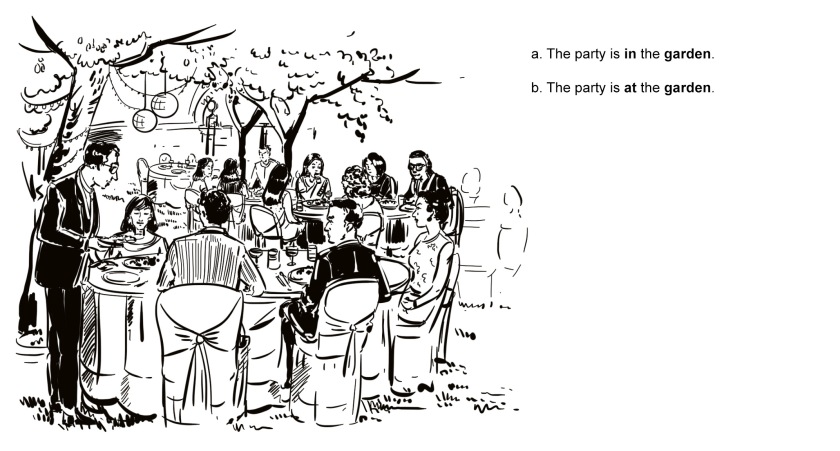
So, here comes the question. Don’t mull over it. Go with your gut feeling. You have two options: a. The party is in the garden. b. The party is at the garden.
Did you say in the garden? Woohoo! That’s correct. A garden is a well-defined space and so we use in. If you got it wrong, no worries. Now you know.
When we talk about spaces that have a specific purpose, then things change. We usually use at. That’s why it is at home and not in home. The word home has specific emotions and meanings attached to it. It’s not a random place.
Now, picture this. You are flying to Colombo for a meeting. You call your friend and say, “Hey, I am at the airport. Do you want me to buy anything for you?” Note that you said at the airport, and not in the airport. So when it comes to airports, train stations, and other places with specific purposes, use at.
This is the really tricky part. Let’s look at another place: a hospital. If you are at the hospital visiting a relative who is a patient there, you say: I’m at the hospital. On the hand, if Rahul is a patient, you say: he is inhospital (UK English). In US English, it would be: he is inthe hospital.
There is more I’d like to tell you about prepositions, but I want these above points to sink in, nice and slowly. So, I’ll end the post here.
If you would like to read my first post on prepositions, click here.
And here is a short video on common errors in the use of prepositions.
Still want more on prepositions? Visit British Council Learning English for prepositions of time and of place.
I’ve noticed that many people do not have time to learn about articles. They’re just not bothered, frankly. But, if you don’t use articles correctly, there will be grammatical errors in your presentations, emails and reports.
This is the third post on articles. In the previous posts, we looked at the indefinite and definite articles.
And now, for the grand finale.
Let us find out about that most mysterious article of all, the third type of article, known as the zero article.
To see the zero article, click twice inside the golden frame below. You will have to click twice, quickly. And then focus on the empty space within the frame. (Make sure you look at all parts of the frame, especially the corners.)
Before we talk more about this type of article we need to be clear about two concepts.
Read these two definitions:
Abstract nouns–An abstract noun is a noun that you cannot touch, see, smell, hear, or taste. For example, peace, love, and imagination are abstract nouns.
Plural count nouns–These are nouns that can be counted. Examples are: masks, beds, and vampires. You can say I see: five masks, three beds, and two vampires.
Did you get that?
Okay then.
We use the zero article before an abstract noun or before a plural count noun.
Simple as that.
Here are two sentences where we use the zero article.
Imagination is the need of the hour.
I don’t meet vampires after sunset.
In both these sentences, there is a zero article before the noun–imagination (abstract noun); vampires (plural count noun).
We are almost done here. I need to tell you about the times when we use the definite article the before an abstract noun or a plural count noun.
We use it when talking about something specific.
For instance: The imagination of a child is limitless.
Or: The vampires in my hometown are quite harmless.
In both these sentences, we are referring to a specific type of noun–the imaginationof a child; the vampires from my hometown.
Now that you know about the zero article, keep an eye out for it. Not people know about this hidden article.
For more on articles, visit British Council LearnEnglish.
Once upon a time, people used to stay at hotels. It was either for business or for tourism. They would check-in and then, after a day or two, check-out. I know, I hear you. We are living in unprecedented times.
Those ‘normal’ days shall return. And my wishes go out to all those reading this post who are from the hospitality sector.
Now, let’s talk about the the — the definite article.
Which option is correct?
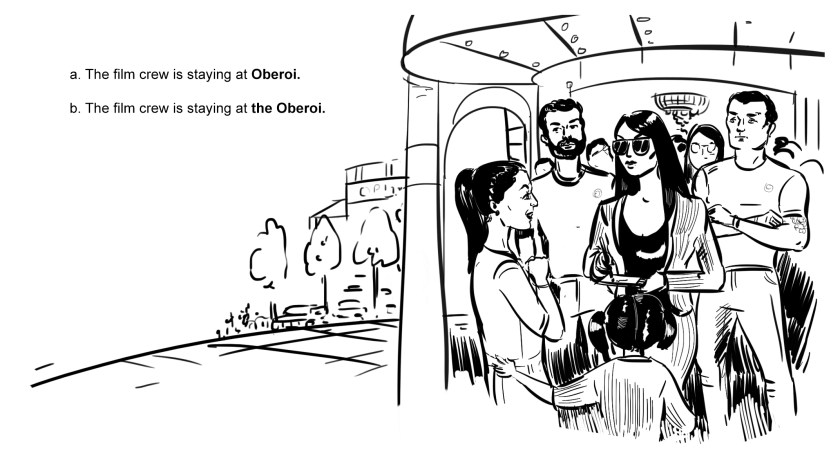
a. The film crew is staying at Oberoi.
b. The film crew is staying at the Oberoi.
(By the way, that’s the name of a hotel group in India, in case you are not from around here.)
Yes, it’s a. You’re 100% correct. This aspect of grammar comes naturally to you.
No, it’s not. Sorry for that. The correct answer is b. (I’m not sure whether you were actually considering the two options, or have just scrolled down to find the answer. So, I need to keep you on your toes. It’s for your own good. Trust me.)
When it comes to hotels, most of the time, we use the definite article the. So, we stay at the Oberoi, or the Taj, or the Radisson, or the Hyatt.
There is an ad with the line: ‘Take me to the Hilton.’ That’s a memorable line.
The definite article, the, creates a feeling of intimacy in the mind of the reader — an example of the subtle, yet effective, influence of the.
Here is another use of the.
Which is the correct option?
a. The conference focuses on opportunities in Middle East.
b. The conference focuses on opportunities in the Middle East.
You may have selected the correct answer (which is b), but tricky it is, especially if someone asks: but why? Don’t skim this part of the post. Slow down. Read carefully. It will help you someday.
With country names we usually do not use the definite article the. There are some exceptions (of course) such as the Netherlands and the Philippines.
However, we use the definite article the before a collection of states. For example: There are many Canadian companies operating in the United States of America. The USA is a collection of states. Similarly, you can live in the European Union, travel to the United Arab Emirates, and then visit your friend in the United Kingdom.
We use the definite article before the phrase: Republic of ______.
So you can start a company in the Republic of South Africa. And you can purchase machinery from the Republic of Korea.
Let’s talk about the Middle East (from the conference above). When it comes to place names that are ‘adjective + place’, we use the. Middle = adjective. East = place. So, there are many logistics companies in the Middle East.
When referring to geographical areas, I suggest you do a bit of research (a one-minute google search should suffice) before adding or subtracting the definite article.
It is: the company has a strong presence in Southeast Asia. And not in: the Southeast Asia. And you’ll have the definite article when saying: the company has a strong presence in the Southeast Asian market.
My previous post gives an introduction to articles. Do read it to get a better understanding of the basics.
Have you ever heard of the zero article? You may be pleasantly surprised to find out about it.
Are you curious to know more about the use (and misuse) of articles? Check out my latest book on Amazon.
This post is about articles such as a and the. After reading the heading, if you thought that this is about newspaper articles, or how to write articles for your blog, then click away. But, if you wish to know more about a’s and an’s, stay and bravely read on.
You’re still here! Articles are overlooked words which add meaning and set the tone in a piece of writing. Learners of English many times drop articles or use them inappropriately. This may be because in their mother-tongues there are no articles. So, if you are in that boat, no worries. You’ll have to prepare your mind to use articles correctly. As always, slow and steady.
Let’s get down to business. There are three articles — the indefinite articles (a, an) and the definite article (the).
Oops… Did I say three articles? Actually, there is one more, an invisible article. Are you aware of such a mysterious article being present (and not present) when you read sentences in blogs, newspapers, and novels?
Before we look at this invisible article, let’s talk about the visible ones.
We use the indefinite article a before a word that starts with a consonant sound. So that would be a face mask or a video call. And we use the indefinite article an before a vowel sound. For example: There is an alligator under your chair or an octopus in the kitchen sink, or an orangutan at the door.
If your doorbell just rang, open the door slowly. Not because orangutans are dangerous, but because you (with your face mask and face shield) might frighten the poor creature. (Hey, I’m just trying to spice up your lockdown life.)
We return to the use of articles. Here comes the tricky part. (What fun would there be if language was without any trapdoors?) So here is the question. (Drum roll, please.) Is it an university? Or a university? Think about.
Read the previous paragraph. What’s the first sound in that word? Although university starts with a vowel, the first sound is a consonant sound. Let’s change tracks, and talk about food.
Picture this. You have taken the first spoonful of your favourite dessert. It’s been a while since you’ve had it, and you exclaim to the whole world: YUM! The first sound in that yum is also the first sound in the word university. It’s a consonant sound. And that is why we have — a university.
The same goes for the phrase European company. It is a European company and not an European company. Clear? Oh… It’s not. Okay, let me elaborate. In the word European, the first sound is a consonant sound. And that sound is the same as the first sound in that most expressive of words: yum.
We use the definite article the to talk about someone or something specific. What’s the difference between: give me a piece of chocolatecake and give me the piece of chocolate cake? In the first sentence, I’m taking about any piece of chocolate cake that is on the table. I’m not referring to a specific one. But, in the second sentence, both of us know which piece of cake I have in mind.
We have shared knowledge.
Now that we have a basic overview of the use of the visible articles, let’s look at how they are used in the real world.
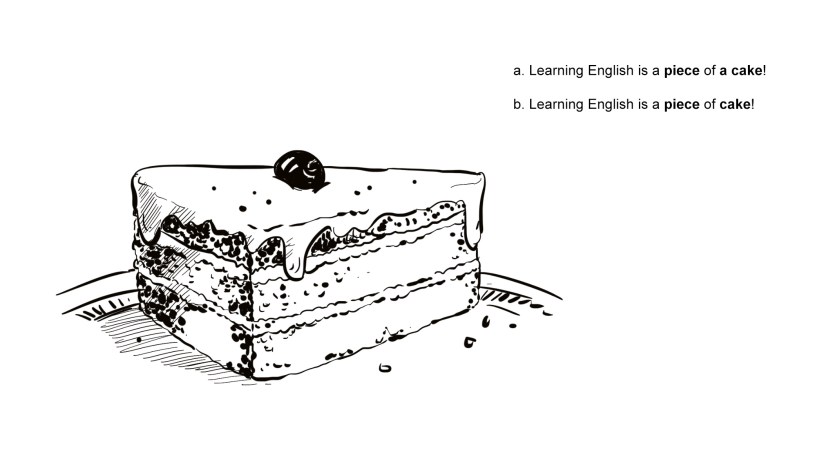
Is it: a. Learning English is a piece of a cake! b. Learning English is a piece of cake!
The answer is b.
When speaking, some people drop/add articles in common expressions. For example, someone told me, “We need to think out of box.” Instead, it should have been, “out of the box.” There are many more cases of this innocent dropping/adding of articles. Keep your ears peeled when people speak.
At the beginning of this post, I said that articles are overlooked words. There is, however, a class of people who pay special attention to these shortest of words. Writers, poets, and wordsmiths, know the value of articles. Marin Luther King Junior, the American civil rights activist, recognized the power of articles. In his famous 1963 speech he used articles to spectacular effect. The title of his speech is ‘I have a dream’. Note: It is not: ‘I have the dream.’
By using the indefinite article, a, the speaker is being understated. There are many dreams out there. This is my dream. By being understated, he amplifies the message. He makes it universal. Here is an excerpt from his speech:
I say to you today, my friends, though, even though we face the difficulties of today and tomorrow, I still have a dream. It is a dream deeply rooted in the American dream.
The articles are in bold. The definite article, the, is used twice, referring to something specific — the difficulties of today… the American dream…. (The audience on that day in 1963 knew exactly what he was referring to. There is shared knowledge between the speaker and his listeners.) Let’s turn our attention to the use of indefinite articles. He uses the phrase — a dream — in the first sentence. In the second sentence, he could have gone with — ‘It is the dream deeply rooted…’ But, where is the poetry in that? The phrase ‘I have a dream’ is used many times in the speech. This repetition brings rhythm, meaning, and poignancy to his message. To understand how that rhetorical magic happens, we need to recognize the presence and nuanced influence of our one letter word — a.
In the next installment, we’ll look at some more uses of articles in the real world away from the pages of grammar books. We shall also meet that elusive fourth article that keeps such a low profile.
In the meantime, watch this video. And when listening, think about the ‘a’ in “I have a dream.” Now, that is a powerful use of the indefinite article.
Some people get emotional when talking about prepositions. It’s true.
I remember a learner who asked me: Why in a chair and not on a chair? His face was distressed, and he was searching for logical reasoning. If you are not sure, by the way, it is: He is sitting in a chair.
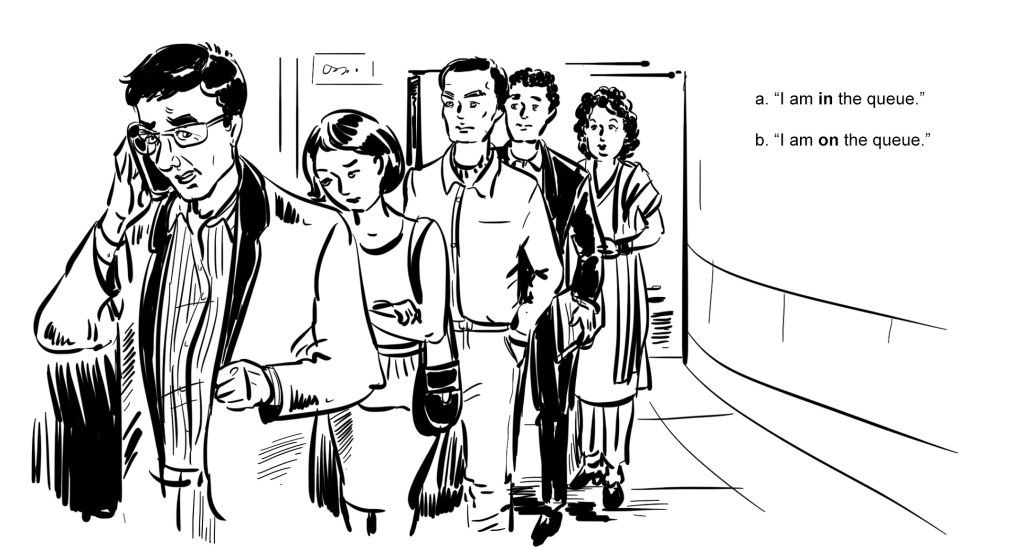
During demonetization a lot of us were standing in front of ATMs, just like these people below. Is that person, who is on the phone, saying: a “I am in the queue.” or b “I am on the queue.” ? (Assuming he knows his prepositions.)
The answer is a.
Many people would have gone for b. In India, we like to use ‘on’ a lot. I don’t know why. When learning English as second language, prepositions can be tiny, tricky words to handle. Is it in or on? At or in? Is there any logic to it all?
My advice is to take it one preposition at a time. Learn it as a chunk with other words that go with it. I’ll give you some reasoning as well. But, for the most part, see if you can naturally associate a preposition with a noun. After some effort, it should be effortless. Automatic.
In this post, let’s look at some commonly used prepositions. A Bollywood actor would say a sentence like: I live in Mumbai. With a city, town, neighborhood, or village, the preposition is in. So, it would be: She lives in Bandra.
Close your eyes. Okay, that may not be practical when you have to read the next sentence. Keep them open. Imagine this. You are on a flight heading to New York. The plane halts in Paris for one hour. You call your friend and say: The plane is at Paris for an hour. No time to visit the city!
Here, if you noticed, we used at and not in. We use at when we are at a point in a journey. We use at with car journeys and train journeys as well. Try it sometime, maybe after this whole crazy covid-19 crisis is over.
When travelling by public transport, where in general you can move around, use on. So, Shilpa is on the plane. Your brother is on the bus, headed to Mysore. Your manager is on the metro. That’s right, on the metro, because it is public transport, and you can move about. For instance, you can walk from your seat to the opening door. If you are travelling in New York, you would say into your cellphone: Hey, I’m on the subway.
In transport that you cannot walk about, where your movement is severely restricted, use in. ‘I’m in an Uber cab.’ And of course, ‘I’m in your car. Where are you?’ If you are sitting on the roof of the car, then you say: ‘I’m on your car.’
If you are taking a private plane (a Learjet, maybe?), where there is not much walking space, you say: I’m in the plane. So, the next time you are in a high-end private airplane, you will know which preposition to use.
Of course, when it comes to a horse, bicycle, or motorbike, you are on and not in. If you are in a motorbike or bicycle, that spells trouble. And I would not wish it upon you.
When you are attending/participating in a group event, use at. So you are at a party, at the match, and at a meeting.
At a meeting? I see you scrunching your eyebrows at that phrase — at a meeting — while saying to yourself hmm. Can’t I say in a meeting? I’ve heard that before, many times. Well, you can. But the meaning is a bit different. At a meeting means that you are, well, attending a meeting. Now, say for instance you are attending a marketing meeting, and your phone rings. You respond with a message: I’m in a meeting. I’ll call you back. This means that you are busy, very busy, and that you will call that person after you have finished with the meeting. The emphasis is on you being engaged in an activity (the meeting).
If you would like to know more about prepositions, do check out Common Indian Errors in Business English. This book looks at the use (or misuse) of prepositions by Indian speakers. It covers other topics as well, such as the use of articles and uncountable nouns. The book is full of images and multiple choice questions, just like the above illustration in this post. By the way, I am its author. And, here is the cover:
A few years ago, I was delivering a training session at a company in Noida (near Delhi, India), and the topic was talking about the future. I noted that the participants were using the same language, over and over again.
Tomorrow morning, we will be meeting the client. Then in the afternoon I will be going to the warehouse. In the evening, theywillbepreparing the report.
will be… will be… will be…
I know–whatever will be, will be.
How many ways can we talk about the future? Some say four, some say more. Interestingly, not many people know about them. That is why many say: will be.
It would be good for you to use different ways to talk about the future. This gives your language variety, allowing you to express different shades of meaning.
In grammar, there is a present tense and a past tense. There is no future tense. This is because there is no specific grammatical form for the future. Instead, we usually talk about the future time using verbs (will and shall) and grammatical structures from other tenses. For example, we could use the present simple to talk about the future.
Does that sound confusing? Read on and find out how.
The Future time
1. Will
This is a common way to talk about the future. You say things like:
I will make breakfast.
I will send the PowerPoint slides in ten minutes.
I will call the manager to find out what is happening.
We use will when we talk about something that we decide to do at the moment of speaking.
When the Terminator says–I’ll be back–he is telling us what is on his mind, right now.
2. going to
This may be a bit tricky.
Stand up. Stretch your arms. Take a deep breath. Sit down. Done? Now, read further.
There are two ways to use the phrase going to.
a. We use going to when we talk about something that has a good chance of happening.
For example, you see dark clouds. And you say, “It is going to rain.” You are making a prediction based on some evidence–those dark clouds.
Another example sentence is: He isgoing to fall.
There is some evidence suggesting that this event could occur. For example, he may be replying to a WhatsApp message while walking down the stairs.
b. We also use going to when we have made a decision in the past, and we are talking about it right now.
Confused? Don’t be. This example should help:
Monday 10 am
Priya: Let’s go for a movie this evening.
Natasha: That’s a good idea. I’ll see what’s playing.
Monday 3 pm
Zach: Hi there! Do you and Priya have any plans later today?
Natasha: Yes. We aregoing to watch a movie.
Here, Natasha is telling Zach about a decision that has been made in the past. And that is why she uses ‘going to’.
Let’s imagine, instead of the Terminator saying, ‘I’ll be back’, he says: I‘mgoing to be back.
What does that mean? It means that he has made a decision in the past and he is telling us about it right now.
Does that make sense?
Just nod your head in agreement. (It’s the Terminator we’re talking about here.)
If your answer is no or maybe, read Natasha’s dialogue again.
Shall is a lot like will. We use it to express a decision we make at the time of speaking.
Nowadays, in general, we don’t use shall that much. Having said that, there are some situations when shall works very well.
Picture this:
You are about to start a meeting at work. There is casual chatter in the room. You look around the table and ask:
“Shall we start?”
Isn’t that a polite, inclusive way to begin?
When you are participating in your next meeting (online or otherwise), see where you can insert a question with shall. For example, “Shall we move on to the next point?”
4. Present Continuous Tense
We use the present continuous tense to talk about plans or arrangements in the future that are already fixed or arranged.
This is an excellent way to talk about the future.
Remember those participants in my session in Noida? They kept on using–will be. Instead they could have said: Tomorrow morning, we are meeting the client. Doesn’t that sound pleasing to your ears? To me, that sounds smoother, more fluid than using will be.
Use the present continuous tense when talking about confirmed plans or arrangements.
This tense works well in a semi-formal / formal business environment.
To get you started, here are some examples:
I am making a presentation this Friday.
(This means that everything is set. The room has been reserved. The participants have been informed.)
We are leaving for Hong Kong tomorrow.
(This means that all arrangements–tickets, hotel accommodation, meetings with vendors–have been made.)
5. Present Simple Tense
We use the present simple to talk about fixed schedules.
For example: the train for Mumbai leaves at 11:00 am every day. This means that it will leave tomorrow at the same time as well.
You can also use the present simple tense when talking about major events in the future.
For example: The Shareholders’ Meeting starts at 9:00 am on 20 December.
If you have a major event in your personal life (the wedding reception is on ….) or in your profession life, use the the present simple tense.
6. Future continuous tense
We use the future continuous tense to talk about something going on at a particular time, or over a period of time, in the future.
For example:
Sam: Can we discuss the proposal tomorrow at 10?
Yoko: No, sorry… I’ll be meeting the sales team between 9 and 11 o’clock.
You can use the future continuous tense when explaining why you won’t be available at a particular time in the future.
What next?
I know that this post may be a bit of an overload. You have just read (or skimmed through) six different ways to talk about the future time.
If you are feeling overwhelmed, here is some advice:
The next time you talk about the future, monitor yourself. Are you using will all the time? Or are there a lot of will be‘s ?
Once you have identified a pattern, the next step is to see how you can enrich your language. In the next meeting you have, see whether you can use shall. For example, you could say: Shall we start the meeting?
Take it easy. Don’t start using all six different ways in one go! Select one way. Use it five to ten times during different interactions / situations. And then move on to the next way. Slow and steady.
By talking about the future in different ways, you express yourself with more precision and clarity.
For more on the future time, read this post from British Council LearnEnglish.
Like to know more about grammar? How about learning about articles.
Yes, I woke up and brushed my teeth with Colgate toothpaste, took a shower with Dove soap, got ready, had Kellogg’s cereal for breakfast, booked an Uber cab on my Samsung cellphone, and left Delhi for Bengaluru airport. After reaching, I took an Ola cab to the Radisson Blu hotel.
All about nouns
Proper nouns
The list above is composed solely of nouns, proper nouns, to be precise. Proper nouns are specific places, persons, or events. And of course, brand names are proper nouns.
Isn’t it amazing that you were able to make sense of and find connections with all (or almost all) of the proper nouns in that list?
We live in a world that is saturated with proper nouns. In our daily lives, many of us have conversations teaming with proper nouns. Do we go to Subway or Pizza Hut for lunch? Coke or Pepsi? Should I buy shoes from Nike or Adidas?
There are other noun types out there. Maybe not as glamorous or enticing. But, they are important.
Common nouns
There are common nouns, which name a class of things, animals, people, or places. Yes, that’s the definition you learned (or memorized) at school. Examples of common nouns are: teacher, student, bird, city, and tree.
Concrete nouns
Then there are concrete nouns: nouns that you can know through your five senses. Words such as keys, tickets, and sunglasses. We deal with a lot of concrete nouns in our daily lives.
There is one type of noun that overshadows all the nouns we have seen till now. This is the most powerful category of nouns.
Abstract nouns
These nouns can inspire you to greatness, and they can make people do terrible things. You cannot see them, hear them, smell them, taste them, nor touch them. I’m talking about abstract nouns. Love. Hate. Justice. Jealousy. Forgiveness. War. Peace. Envy. Compassion. The list goes on and on. All these words are abstract nouns.
Now that you know the value of abstract nouns. Start thinking about them as well. Are you feeling jealousy? Or pity? Or compassion? Or … Abstract nouns help you introspect.
In 2008, Barack Obama’s election campaign centered on an abstract noun. It proved to be a successful choice. It captured the imagination and aspirations of the voting public. The abstract noun was: hope.
Is this correct? Its my life. Nope. Why not? Because there is no verb in that sentence. It should be: It’s my life.
It’s can mean two things: it is — or — it has. It all depends on the context. In our example sentence — It’s my life = It is my life. It is not: It has my life.
Let’s look at another sentence: It’s been a while since we last met. Now, here, it’s = it has.
Its is another dish altogether. And it has two different and distinct flavors.
1. Possessive pronoun
image from: superawesomevectors.com
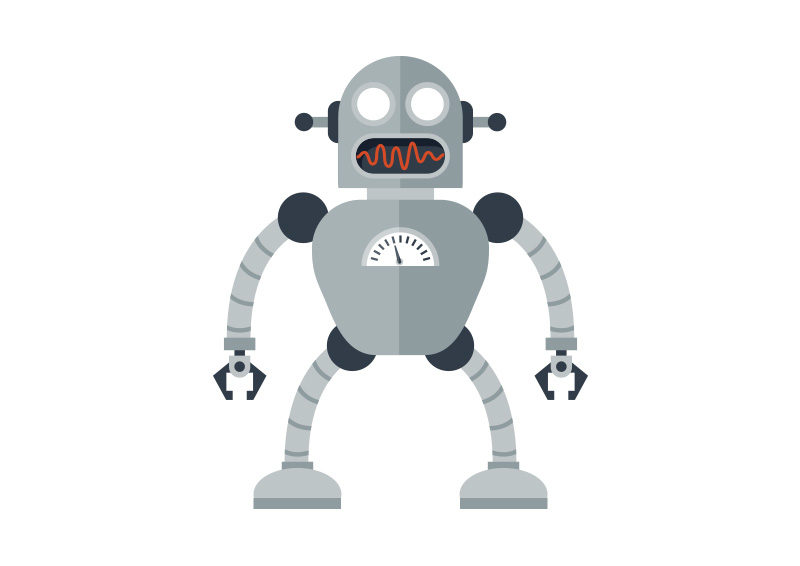
Imagine you have a robot (like the one above). In general, we consider a robot to be a thing. So we would say: it is washing the dishes.
Let’s look at some dialogue —
Your friend: Whose book is that?
You (pointing to the robot): Oh… That’s its.
Your friend: I didn’t know robots can read.
That is one way of using its. Here its acts as possessive pronoun. If the book was yours, you would say: Oh… That’s mine. (Mine is another possessive pronoun, by the way.)
You are still reading this post. That means you are determined to understand it’s vs its. A positive sign. We have one more use of its and then we’re done. Promise.
2. Possessive adjective
A friend asks you: Whose book is that?
You (pointing to the robot): Oh… That’s its book.
Here its acts as a possessive adjective. It gives us more information about the book. If it is your book, you would say: Oh… That’s my book.
Do you get it?
Are you a bit confused? I hope not. Don’t worry about all the grammatical jargon (possessive pronoun, possessive adjective). Just think about when to use it’s and its.
Keep in mind that its can be used either as a pronoun (a word that replaces a noun) or as an adjective (a word that describes a noun).
Phew! Done.
Next time someone emails you: Its okay. You know what is not okay!







 Its or it’s. What’s the difference?