I’m sure you’ve seen this line below the golden arches before. McDonald’s has even trademarked it. Why is so catchy? Love is a state verb. That’s the short answer.
Let’s find out more about state verbs. These verbs fall into four categories.
The four categories of state verbs
Mental states. This includes verbs such as know, think, and believe. For example: She knows a lot about astronomy.
Emotional states, such as like, love, prefer, and hate. For example, I like to wake up early in the morning.
The senses–see, hear, smell, and taste. For instance, this pizza margerita tastes delicious.
Possession. Verbs such as: own, have, and possess. For example: I own a bicycle.
What you need to know
Here is your takeaway from this post. We do not add an ‘ing’ at the end of a state verb.
So, we say: I prefer speaking French. Not: I am preferring speaking French.
We say: Yoko has a degree in chemistry. Not: Yoko is having a degree in chemistry.
But, wait a second. Can’t I say: I’m having a snack? Yes, you can.
In this case, ‘having’ is not a state verb–it’s an action verb. Action verbs are verbs such as walk, talk, and sleep. With action verbs, we can add an ‘ing’ to show an action over a period of time. For example: He is walking in the garden.
I’m having a snack = I am eating a snack.
‘Having’ here is an action verb. It is not a state verb. Does that make sense?
Now, what about I’m loving it? Is ‘love’ a state verb or an action verb? Yes, it is a state verb. Usually, if we were to follow the rules of grammar, we would not add an ‘ing’. It should be: I love it.
Yawn. That sounds so ordinary.
The line–I’m loving it–bursts into your mind. Why? Because it sounds fun. It sounds different. By breaking the rules of grammar, this line becomes memorable.
The next time you see ‘I’m lovin it’, think about state verbs. Recollect the rule about not using ‘ing’. You’ll appreciate why that grammatically incorrect sentence deserves to be trademarked.
By the way, the use of love in the ‘ing’ form has become more common. You may here the sentence, ‘I’m loving your work’. So, using ‘loving’ may not raise eyebrows from English teachers, as it would have in the past.
As that well-known philosopher, Bob Dylan, once sang: The times, they are a-changin’.
If. That one-syllable word opens the door to a world of imagination.
Whenever we read a novel or watch a Netflix series, we slip into the unreal world defined by if.
The second conditional is about imaginary or unreal situations. Just like the image above of the two people on Mars gazing up in the direction of earth.
The form of the second conditional is:
if + past tense, would + bare infinitive
If you lived on Mars, would you miss earth?
If you enjoy stories, plays, and films, then the second conditional is for you.
But, the second conditional can multi-task. In fact, there are many occasions where you can use this conditional at work.
Three ways to use the second conditional at work
Giving advice or making a suggestion
If you want to give advice in a tactful way, you could say:
If I were you, I would send the data to HQ by this afternoon.
Doesn’t that sound better than saying:
You should send the data to HQ by this afternoon.
You could use the second conditional with colleagues and with people who report to you. When you say, if I were you, you are putting yourself in their shoes. In a sense, you are nudging them to do something. Nudging is good, right?
Brainstorming
If we opened pop-up restaurants in all major cities, would people try the food?
If we offered a discount for the festive season, would we liquadate all our stock?
If the ad campaign focused only on Instagram, would we reach our target audience?
What do you think of these three second conditional sentences?
To my mind, these sentences invite thoughtful discussion. They ask the people in the room to consider other possibilities. The space for interaction and ideas expands. Thinking caps are put on.
Can you picture yourself using a second conditional sentence in your next meeting?
Proposing a solution
If we added two more associates to the team, would the client agree?
If the factory increased capacity utilization by 10%, would they deliver the shirts by Christmas?
Perhaps you wish to make a proposal. Using the second conditional is an indirect way of doing so. Just like in the case of brainstorming, it promotes meaningful discussion.
If you want to reach a consensus in the team, use the second conditional. It is an inclusive way of arriving at a decision.
Takeaway
Using the second conditional makes you sound more professional. By asking these tentative questions, you soften your language. You become more inclusive. You encourage meaningful conversations.
If that is the kind of person or leader you wish to be, then use the second conditional at least once today.
You can scroll up to review how to make a second conditional sentence–go to the form.
Since you’ve read till the end, I have a bonus for you.
The next time you hear the song, If I were a boy, you’ll be able to identify which conditional it is in. Wouldn’t that feel satisfying?
Thanks for singing the second conditional, Beyonce!
In this post, we have looked at the second conditional. Here are posts on two other conditionals — the zero conditional and the first conditional. If I were you, I would….
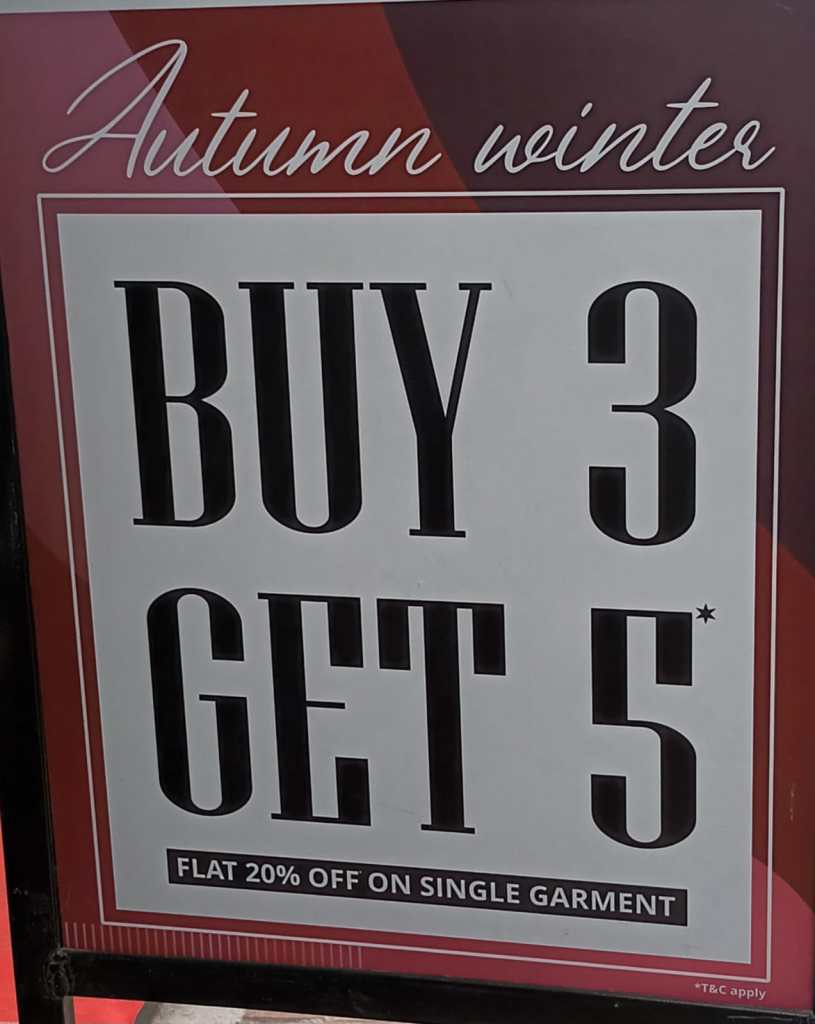
This photo is from a local neighborhood shop. To read the offer fully, it would be–if you buy 3 shirts, you get five shirts. Presto! And just like that, we have a sentence in the zero conditional.
The zero conditional is used to convey 100% certainty.
For instance, these sentences are in the zero conditional:
Condition, result
If you freeze water, it becomes ice.
When you melt ice, it becomes water.
The first part of the sentence is the condition. If that condition is met, the result is guaranteed.
In case you are itching to make more sentences in the zero conditional, use this form:
If + present simple, present simple
If you heat pure gold to 1064oCelsius, it melts.
As can be seen from these sentences above, the zero conditional is used for scientific facts.
I can hear you thinking…. This post is about melting ice and gold. What does this have to do with me?
As you now know, we use the zero conditional when talking about a result that we are a 100% sure of. So, we can use it for rules, policies, laws, and procedures. Has anyone told you this zero conditional sentence?
‘If you don’t update your password, you can’t access your account.’
Now, doesn’t that sound all too familiar? And I’m sure we have all read something along these lines–
If you wish to cancel your subscription, click the button below.
Yes, you have been reading zero conditional sentences for quite a while. And, the next time you spot an irresistible offer such as buy 1,get 1 free— you’ll know which conditional it is!
If you wish to know about the first conditional, click here.
Do you do a lot of brainstorming at work? If yes, then the second conditional is what you could use.




 amalfabian