
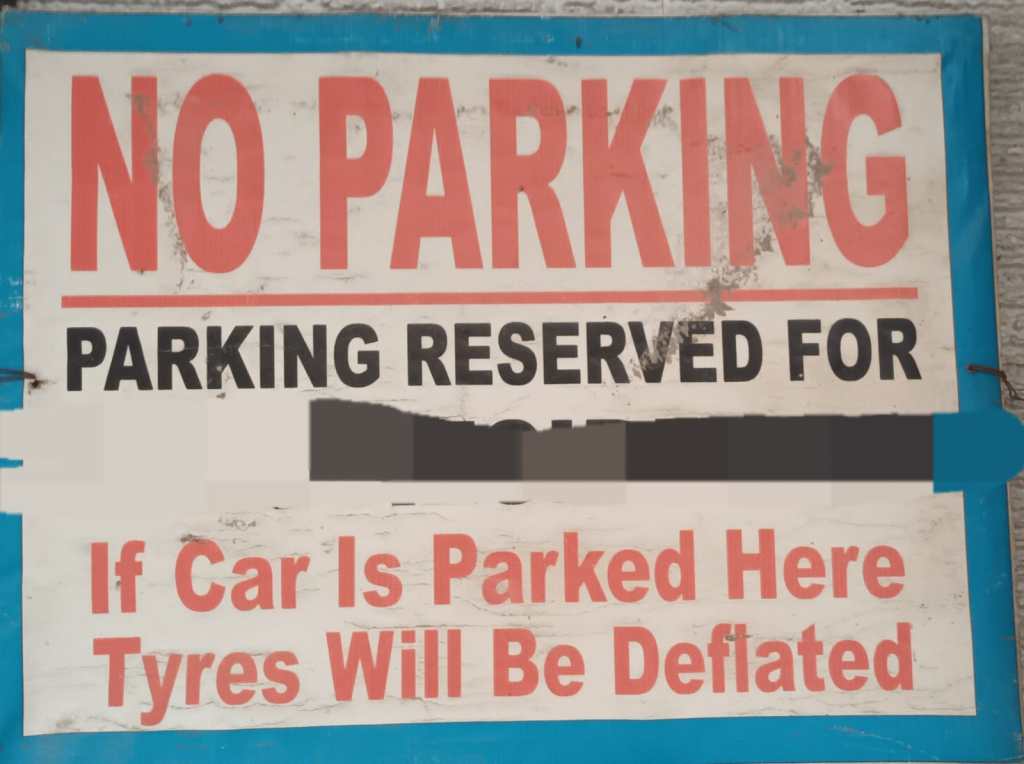
If car is parked here, tyres will be deflated.
Gulp… These people mean business. That is a no-nonsense message. Nobody would dare park their car near that sign.
You may have noticed that there are some grammatical and spelling errors in this memorable line. Let’s clean it up.
If you park your car here, its tires will be deflated.
Luckily for us, this sentence is in the first conditional, providing a teaching moment.
The first conditional is about things that are likely to happen in the future.
There are two components in the first conditional.
The first is the condition–if clause. And the second is the result–will clause.
condition / result
If you park your car here, its tires will be deflated.
The form is: if + present simple, will + infinitive
Could we use the first conditional in our daily lives? The answer is: yes.
Here are some examples:
If the client asks for a further discount, we’ll have to walk away.
If that movie comes to town, I’ll watch it.
You can switch the clauses around as well.
We’ll have to walk away if the client asks for a further discount.
Note that here, we do not need to use a comma to divide the two clauses.
As you can see, there are many instances when we can use the first conditional–at work and outside.
When do you use the first conditional?
Now that you know about the first conditional, you’re all set to find out about the zero conditional. It’s all about facts.
If on the other hand, you wish to enter the world of speculation, consider using the second conditional.

 amalfabian
2 thoughts on “Do you use the first conditional?”