
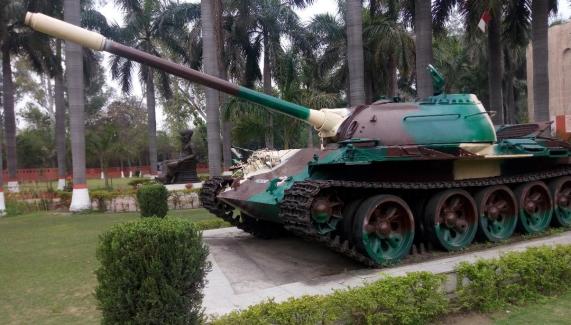
Photo taken at the Maharaja Ranjit Singh War Museum in Ludhiana, Punjab
At times, it may seem that there is more war than peace at work.
Here are four idioms that may reflect what is happening at your office. See if you can use them.
Four idioms derived from war
to cross the Rubicon
During Roman times, the modest river Rubicon marked the boundary from where Gaul (France) ended and Italy began. As a rule, Roman generals returning to Italy disbanded their armies before crossing the Rubicon to enter Italian soil.
Of course, the victorious and ambitious Julius Caesar thought otherwise. He crossed the Rubicon with his battle-hardened army and thus started a civil war.
To cross the Rubicon is take a decision from which there is no turning back.
An example sentence: By agreeing to consider the proposed changes, the Minister has crossed the Rubicon.
to look daggers at somebody
Quite simply, this means to look sharply or furiously at someone.
“At the meeting, the production manager looked daggers at me. What did I do?”
a loose cannon
In sixteenth-century English warships, cannons were mounted on carriages. When the ships swayed back and forth, some of these huge guns would roll about dangerously, endangering the crew.
In today’s world, a loose cannon is a person who behaves in an unpredictable way–often causing some form of disorder. I’m sure you’ve come across at least one loose cannon this year.
“Careful, he is known to be a loose cannon.”
on the warpath
The warpath was the route North American Indians would take to meet their adversary.
Nowadays, the term has come to mean being in an aggressive mood and looking for a fight.
“Avoid Prashant. He’s on the warpath today!”
I used Dictionary of Idioms and their origins by Linda + Roger Flavell as a reference for this post. If you would like to learn more about idioms and their origins, do pick this book up.
I’m sure you have heard this idiom before. He has a chip on his shoulder. But, do you really know what it means?
Ever wondered about vocabulary related to the moon?

 amalfabian
2 thoughts on “4 idioms related to war”